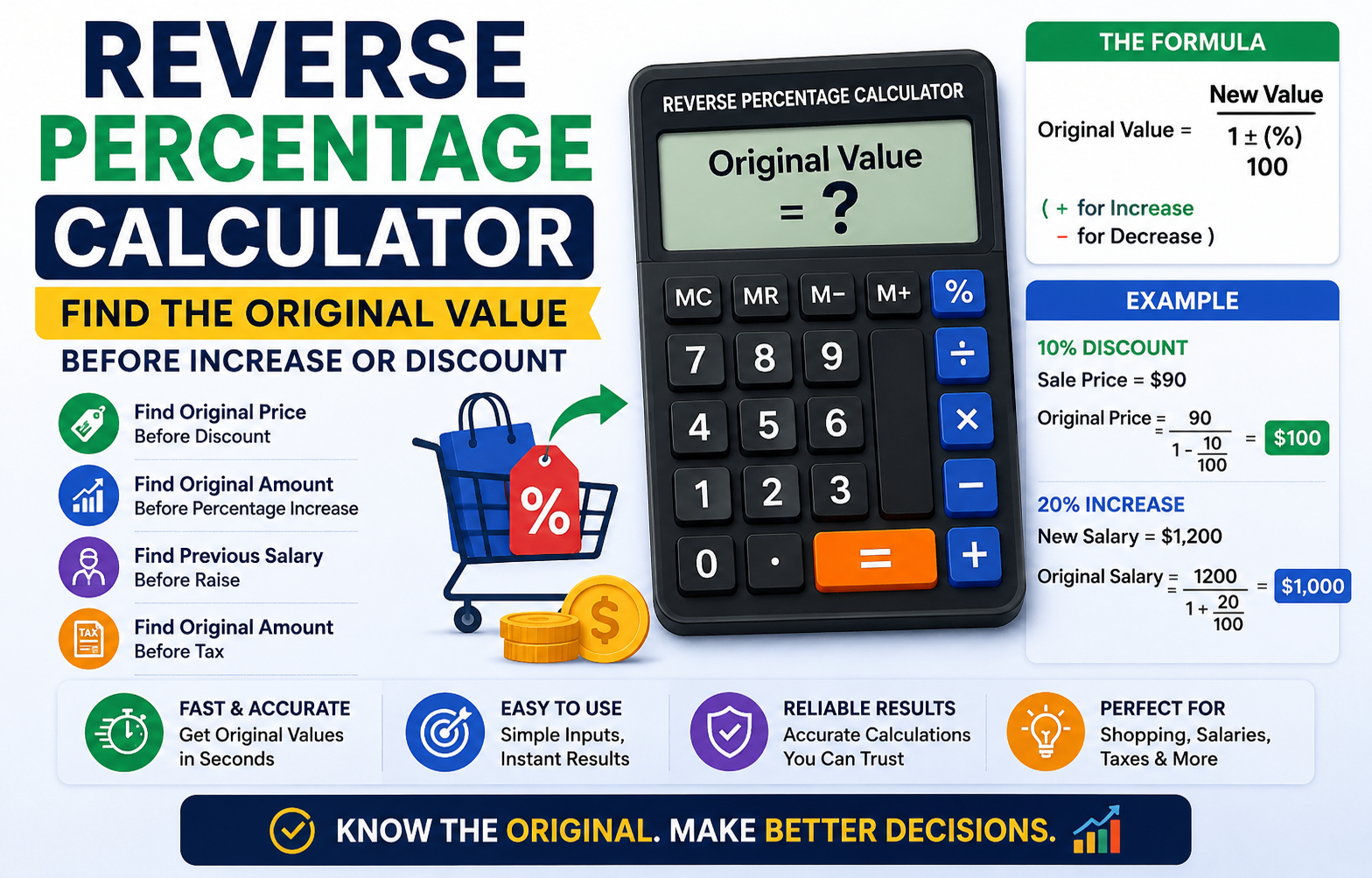
Have you ever looked at a discounted product and wondered what the original price was before the sale? Or maybe you received a salary increase and wanted to know your previous salary before the raise?
These situations involve something called reverse percentage calculations.
Instead of finding a percentage of a number, reverse percentage calculations work backward. They help you determine the original amount before a percentage increase, decrease, discount, or tax was applied.
A Reverse Percentage Calculator makes this process simple, fast, and accurate. Rather than solving equations manually, you can instantly find the original value with just a few inputs.
In this guide, you’ll learn how reverse percentages work, the formulas involved, practical examples, and why using a Reverse Percentage Calculator can save both time and effort.
Visit Now:Salary and Tax Estimator USA
What Is a Reverse Percentage?
A reverse percentage is used to calculate the original amount before a percentage change occurred.
Normally, percentage calculations move forward.
For example:
- Find 20% of 500
- Calculate a 15% discount
- Determine a 10% increase
Reverse percentages do the opposite.
They answer questions such as:
- What was the original price before a 30% discount?
- What was my salary before a 12% raise?
- What was the item’s price before tax was added?
- What was the value before a percentage decrease?
Reverse percentages are commonly used in business, shopping, finance, and education.
Read More:Percentage Difference CalculatorWhat Is a Reverse Percentage Calculator?
A Reverse Percentage Calculator is an online tool that calculates the original value before a percentage increase or decrease.
Instead of performing calculations manually, users simply enter:
- Final value
- Percentage change
- Increase or decrease option
The calculator immediately displays:
- Original value
- Percentage adjustment
- Amount added or removed
- Accurate results
This saves time and reduces mistakes.
Reverse Percentage Formula
The formula depends on whether the percentage represents an increase or a decrease.
Formula for Percentage Increase
Original Value = Final Value ÷ (1 + Percentage ÷ 100)
Formula for Percentage Decrease
Original Value = Final Value ÷ (1 − Percentage ÷ 100)
These formulas allow you to work backward and determine the starting amount.
How to Calculate Reverse Percentage
The process is straightforward.
Step 1: Identify the Final Value
Determine the amount after the percentage increase or decrease.
Step 2: Identify the Percentage
Know the percentage involved.
Examples:
- 10%
- 15%
- 25%
- 40%
Step 3: Convert Percentage to Decimal
Divide the percentage by 100.
Example:
20%
= 0.20
Step 4: Apply the Formula
Use the appropriate formula based on whether the value increased or decreased.
Reverse Percentage Increase Example
Suppose your salary increased by 10%.
Your current salary is:
$4,400
What was the original salary?
Formula:
Original Value
= 4,400 ÷ 1.10
= 4,000
Answer:
Your original salary was $4,000.
Reverse Percentage Discount Example
A laptop costs $700 after receiving a 30% discount.
What was the original price?
Formula:
Original Value
= 700 ÷ 0.70
= 1,000
Answer:
The original price was $1,000.
Read More:Percentage Increase CalculatorReverse Percentage Calculator Examples
Examples make reverse percentages much easier to understand.
Example 1: Reverse Discount
Sale Price:
$150
Discount:
25%
Formula:
150 ÷ 0.75
= 200
Answer:
Original Price = $200
Example 2: Reverse Increase
Final Value:
$660
Increase:
10%
Formula:
660 ÷ 1.10
= 600
Answer:
Original Value = $600
Example 3: Tax Calculation
Price Including Tax:
$540
Tax Rate:
8%
Formula:
540 ÷ 1.08
= 500
Answer:
Price Before Tax = $500
Example 4: Salary Raise
New Salary:
$5,750
Increase:
15%
Formula:
5,750 ÷ 1.15
= 5,000
Answer:
Original Salary = $5,000
Example 5: Reduced Price
Current Value:
$900
Reduction:
10%
Formula:
900 ÷ 0.90
= 1,000
Answer:
Original Amount = $1,000
Reverse Percentage Calculator for Discounts
Discounts are one of the most common applications of reverse percentages.
Suppose a store advertises:
“40% OFF”
Sale Price:
$180
What was the original price?
Formula:
180 ÷ 0.60
= 300
Original Price:
$300
Using a Reverse Percentage Calculator allows shoppers to quickly determine whether a deal is worthwhile.
Reverse Percentage Calculator for Tax
Taxes increase the price consumers pay.
Sometimes people only know the final amount.
Example:
Final Cost:
$1,080
Tax:
8%
Formula:
1,080 ÷ 1.08
= 1,000
Original Price:
$1,000
Businesses frequently use reverse percentages for tax calculations.
Reverse Percentage in Business
Companies use reverse percentages regularly.
Applications include:
- Revenue analysis
- Pricing strategy
- Sales discounts
- Cost evaluation
- Profit calculations
- Market analysis
Revenue Example
Current Revenue:
$920,000
Growth Rate:
15%
Original Revenue:
920,000 ÷ 1.15
= 800,000
Previous revenue was $800,000.
Businesses use these calculations to track performance over time.
Reverse Percentage in Finance
Financial professionals rely heavily on reverse percentages.
Common applications include:
- Investment growth
- Interest calculations
- Portfolio analysis
- Savings targets
- Loan balances
Investment Example
Investment Value Today:
$12,600
Growth:
5%
Formula:
12,600 ÷ 1.05
= 12,000
Original investment:
$12,000
Investors use reverse calculations to analyze gains.
Reverse Percentage in Education
Students also benefit from reverse percentage calculations.
Examples include:
- Exam scores
- Grade adjustments
- Attendance analysis
- Academic statistics
Score Example
A student’s marks increased by 20%.
New Score:
96
Formula:
96 ÷ 1.20
= 80
Original Score:
80
Reverse percentages help educators compare performance over time.
Reverse Percentage vs Percentage Calculator
Although both tools deal with percentages, they serve different purposes.
Percentage Calculator
Calculates a percentage of a value.
Example:
20% of 400
Answer:
80
Reverse Percentage Calculator
Finds the original value before the percentage change.
Example:
Final value = 400
Increase = 20%
Answer:
333.33
Understanding the difference is important when choosing the correct calculator.
Why Use a Reverse Percentage Calculator?
Manual calculations can be time-consuming.
A Reverse Percentage Calculator provides several advantages.
Faster Calculations
Results appear instantly.
No manual formulas are needed.
Improved Accuracy
Calculators reduce human error.
Answers are more precise.
Easy for Everyone
No advanced mathematics skills are required.
Anyone can use the calculator.
Saves Valuable Time
Businesses and professionals often process multiple calculations daily.
A calculator increases efficiency.
Works Anywhere
Most online calculators work perfectly on:
- Mobile phones
- Tablets
- Desktop computers
- Laptops
Calculations can be performed anytime.
Common Reverse Percentage Questions
What was the Original Price Before a 20% Discount?
Sale Price:
$160
Formula:
160 ÷ 0.80
= 200
Answer:
Original Price = $200
What was the Original Value Before a 15% Increase?
Current Value:
$690
Formula:
690 ÷ 1.15
= 600
Answer:
Original Value = $600
What was the Price Before 8% Tax?
Price After Tax:
$432
Formula:
432 ÷ 1.08
= 400
Answer:
Price Before Tax = $400
Original Amount Before a 25% Reduction
Current Value:
$750
Formula:
750 ÷ 0.75
= 1,000
Answer:
Original Value = $1,000
Tips for Calculating Reverse Percentages
Reverse calculations become easier with practice.
Understand Percentage Changes
Always determine whether the percentage represents:
- An increase
- A decrease
Using the wrong formula leads to incorrect answers.
Convert Percentages Correctly
Examples:
10%
= 0.10
20%
= 0.20
35%
= 0.35
Mistakes in decimal conversion often cause errors.
Use Online Tools
Large values can be difficult to calculate manually.
A Reverse Percentage Calculator provides faster and more reliable answers.
Double-Check Results
Estimating the answer beforehand can help verify accuracy.
Benefits of an Online Reverse Percentage Calculator
A Reverse Percentage Calculator offers several advantages.
✔ Instant calculations
✔ Accurate results
✔ Easy to use
✔ No formulas to memorize
✔ Saves time
✔ Useful for students
✔ Great for businesses
✔ Helpful for investors
✔ Supports financial planning
✔ Available on all devices
Whether you’re analyzing discounts, tracking business growth, or calculating tax values, reverse percentage tools simplify the process.
Frequently Asked Questions
What is a Reverse Percentage Calculator?
A Reverse Percentage Calculator is an online tool that helps determine the original value before a percentage increase, discount, or decrease occurred.
How do you calculate a reverse percentage?
Divide the final amount by the percentage multiplier.
For increases:
Original Value = Final Value ÷ (1 + Percentage ÷ 100)
For decreases:
Original Value = Final Value ÷ (1 − Percentage ÷ 100)
Where is the reverse percentage used?
Reverse percentages are commonly used in shopping, finance, taxation, education, and business analysis.
Why is the reverse percentage important?
It helps people identify original values, compare prices, evaluate growth, and understand discounts more clearly.
Is a Reverse Percentage Calculator accurate?
Yes. Online calculators provide instant and highly accurate results, reducing manual errors.
Conclusion
A Reverse Percentage Calculator is an incredibly useful tool for finding the original value before a percentage increase, discount, tax, or reduction was applied.
Whether you’re checking the original price of a discounted item, determining your previous salary before a raise, or analyzing business growth, reverse percentage calculations make the process simple and efficient.
Although understanding the formulas is helpful, using a Reverse Percentage Calculator saves time, improves accuracy, and eliminates unnecessary effort.
With the right calculator, uncovering the original value behind any percentage change becomes quick, easy, and stress-free.