Percentages are everywhere. You see them on price tags, exam results, bank statements, restaurant bills, and even in the news. Yet, a lot of people still open a calculator app and start pressing random buttons whenever they need to figure out a percentage. If that sounds like you, don’t worry — you’re not alone. Percentages confuse almost everyone at some point, especially when the numbers get a bit tricky.
That’s exactly why a percentage calculator exists. It’s a simple online tool that takes the guesswork (and the headache) out of percentage math. You type in your numbers, hit calculate, and you get your answer in less than a second. No formulas to memorize, no long division, no mental gymnastics.
In this article, we’ll talk about what a percentage calculator actually does, why it’s so useful in everyday life, how the math behind it works, and some real situations where it can save you time and stress.
Read More: Salary and Tax Estimator USA
What Exactly Is a Percentage?
Before we jump into calculators, let’s quickly talk about what a percentage really means. The word “percent” comes from Latin, and it basically means “per hundred.” So when you say 25%, you’re really saying 25 out of every 100.
This idea makes percentages a handy way to compare things, no matter how big or small the original numbers are. Whether you’re comparing test scores, sales growth, or discounts on a jacket, percentages give everyone a common scale to understand things quickly.
The problem is, while the idea is simple, the actual calculations can get messy. That’s where a percentage calculator steps in.
What Is a Percentage Calculator?
A percentage calculator is an online tool that helps you solve percentage-related problems instantly. Instead of manually working through the math, you just enter the values you know, and the calculator does the rest.
Most percentage calculators can handle a variety of common questions, such as:
- What is X% of Y?
- X is what percent of Y?
- What is the percentage increase or decrease between two numbers?
- If a number increases by X%, what’s the new value?
- If a number decreases by X%, what’s the new value?
A good percentage calculator isn’t just built for one type of question — it’s flexible enough to handle whatever percentage problem you throw at it. That’s what makes a “global” percentage calculator so useful. It’s not limited to one use case like discounts or grades. It works for finance, education, health, shopping, business, and pretty much anything else involving percentages.
Read More:How to Calculate PercentageWhy People Actually Need This Tool
You might be thinking, “I learned percentages in school, why would I need a calculator for this?” Fair question. But here’s the thing — knowing the concept and doing the math quickly under pressure are two very different things.
Let’s look at a few everyday situations where people reach for a percentage calculator instead of doing it by hand.
Shopping and discounts. You’re standing in a store, and there’s a sign that says “30% off.” You want to know the final price before you get to the counter. Doing that math in your head while juggling bags and a coffee cup isn’t exactly fun. A quick calculation on your phone settles it in seconds.
Restaurant tips. Figuring out 15%, 18%, or 20% of a bill isn’t hard, but when you’re splitting the bill with friends, and everyone has a different opinion about how much to tip, a calculator keeps things simple and avoids awkward arguments over the check.
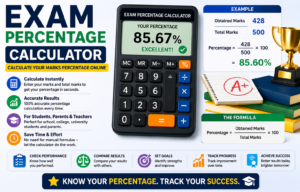
Exam and test scores. Students often need to know what percentage they scored on a test or how many more points they need to reach a certain grade. Teachers use percentage calculators too, especially when grading large batches of assignments.
Salary hikes and deductions. If your company gives you a 10% raise, you probably want to know exactly how much extra you’ll be taking home. The same goes for tax deductions, which are almost always expressed as percentages.
Business and finance. Business owners deal with percentages constantly — profit margins, growth rates, interest rates, commission structures. Getting these numbers right matters because small errors can lead to big financial mistakes.
Health and fitness. Body fat percentage, weight loss goals, or tracking how much progress you’ve made toward a target — these all involve percentage calculations too.
As you can see, percentages sneak into almost every part of daily life. Having a reliable, fast tool for this isn’t a luxury; it’s genuinely useful.
Read More:Percentage Increase Calculator How the Math Works (In Simple Terms)
Even though a calculator does the work for you, it helps to understand the logic behind it. Here’s the basic idea, explained without any confusing jargon.
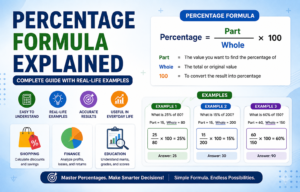
Finding a percentage of a number
If you want to know what 20% of 150 is, you multiply 150 by 20, then divide by 100.
150 × 20 ÷ 100 = 30
So, 20% of 150 is 30.
Finding what percentage one number is of another
Let’s say you scored 45 out of 60 on a test, and you want to know your percentage. You divide the score by the total, then multiply by 100.
45 ÷ 60 × 100 = 75
So, you scored 75%.
Calculating percentage increase or decrease
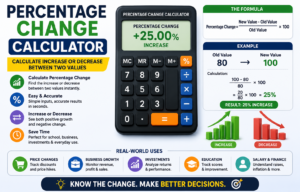
Say a product’s price went from 200 to 250. To find the percentage increase, you subtract the old value from the new value, divide by the old value, then multiply by 100.
(250 − 200) ÷ 200 × 100 = 25
So, the price increased by 25%.
These formulas aren’t complicated once you see them written out, but doing them quickly and accurately, especially with decimals or large numbers, is where mistakes usually happen. That’s the exact gap a percentage calculator fills.
What Makes a Good Percentage Calculator
Not every percentage calculator is built the same way. Some are basic and only handle one type of calculation. Others are more complete and cover multiple percentage scenarios in one place. Here’s what to look for in a solid, reliable calculator:
Simplicity. You shouldn’t need a manual to use it. Clear input boxes, clear labels, and an instant result.
Multiple calculation types. A good calculator should let you calculate a basic percentage, a percentage increase or decrease, and reverse percentage problems, all from the same page.
Accuracy. This one is obvious, but it matters. The tool should give you a precise answer every time, without rounding errors that throw off your numbers.
Speed. The whole point of using a calculator online is to save time. If it takes longer to figure out than doing the math by hand, it’s not doing its job.
Accessibility. A good percentage calculator should work smoothly on both mobile and desktop, since people often need quick answers while they’re out shopping or in the middle of a task.
No unnecessary steps. You shouldn’t have to create an account, download anything, or click through five pages just to get a simple answer.
When a calculator checks all these boxes, it becomes something you’ll actually want to use regularly, not just something you stumble upon once and forget about.
Common Mistakes People Make With Percentages
Even with a calculator handy, it helps to understand a few common percentage mistakes so you can double-check results and avoid confusion.
One common mistake is confusing the percentage increase with the final value. If something increases by 50%, people sometimes think the new value is 50% of the original, when really it’s 150% of the original.
Another mistake happens with a percentage decrease followed by a percentage increase (or vice versa). Many assume it cancels out and returns to the original number, but it usually doesn’t, because the second percentage is calculated on a different base number.
People also mix up “percentage of” and “percentage change.” Saying “40% of 200” is very different from saying “a 40% change from 200.” Keeping these terms clear avoids a lot of confusion.
A percentage calculator won’t correct your understanding of these concepts, but it does help you catch errors, since you can quickly test different numbers and see how the results shift.
Final Thoughts
Percentages are a small part of math, but they show up in almost every corner of daily life — from your grocery bill to your paycheck to your report card. Instead of relying on shaky mental math or scribbling numbers on a napkin, a percentage calculator gives you a fast, accurate, and stress-free way to handle these calculations.
Whether you’re a student trying to figure out your grade, a shopper checking a discount, a business owner calculating profit margins, or just someone curious about a quick percentage question, having a reliable tool at your fingertips makes life just a little bit easier.
At the end of the day, the goal isn’t to make you dependent on a calculator — it’s to save you time and reduce the chances of a silly mistake. And when the numbers matter, whether it’s your paycheck or your grade, a percentage calculator is one of those small tools that quietly makes a big difference.