Have you ever looked at a ratio like 2:3, 5:8, or 18:25 and wondered what those numbers mean as percentages? Ratios are commonly used in mathematics, business, finance, education, sports, and even cooking. However, percentages are often much easier to understand because they express values out of 100.
For example, if a classroom has a ratio of 2 boys for every 3 girls, it’s often more helpful to say that 40% of the class are boys and 60% are girls. This makes the information easier to compare and understand.
That’s exactly what a Ratio to Percentage Calculator does. Instead of solving the calculation yourself, you simply enter the ratio values, and the calculator instantly converts them into percentages.
In this guide, you’ll learn how to convert a ratio into a percentage, understand the formula, work through step-by-step examples, explore real-life uses, and discover why an online calculator is the quickest and most accurate solution.
Visit Now:Salary and Tax Estimator USA
What Is a Ratio?
A ratio is a mathematical way of comparing two or more quantities.
Ratios show the relationship between values and are usually written using a colon (:).
Examples include:
- 1:2
- 2:5
- 3:4
- 7:13
- 15:25
For example, a ratio of 3:5 means that for every 3 units of one quantity, there are 5 units of another.
Ratios are commonly used in:
- Mathematics
- Science
- Business
- Finance
- Statistics
- Sports
- Cooking
- Engineering
While ratios are excellent for comparing values, percentages often make the comparison easier to understand.
Read More:Exam Percentage CalculatorWhat Is a Percentage?
A percentage represents a value out of 100.
The word percent literally means “per hundred.”
Examples:
- 10% means 10 out of every 100.
- 25% means one-quarter.
- 50% means half.
- 75% means three-quarters.
- 100% means the whole amount.
Converting ratios into percentages makes data more meaningful, especially in reports, presentations, and everyday calculations.
What Is a Ratio-to-Percentage Calculator?
A Ratio to Percentage Calculator is an online tool that converts every value in a ratio into its percentage of the total.
Instead of performing multiple calculations manually, you simply:
- Enter the ratio values.
- Click the Calculate button.
- Instantly view the percentage for each part.
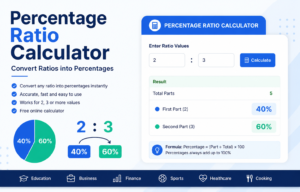
For example:
Ratio:
2 : 3
Result:
- First value = 40%
- Second value = 60%
The calculator works with:
- Two-part ratios
- Three-part ratios
- Four-part ratios
- Multi-value ratios
Ratio to Percentage Formula
The formula is simple and works for every ratio.
Step 1: Find the Total
Add all the numbers in the ratio.
Total = Sum of all ratio values
Step 2: Divide Each Part by the Total
Divide each ratio value by the total.
Step 3: Multiply by 100
Convert the decimal into a percentage.
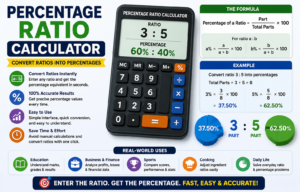
Percentage = (Ratio Part ÷ Total Ratio) × 100
Repeat the calculation for every part of the ratio.
How to Convert a Ratio to a Percentage
Let’s solve a practical example.
Example 1
Ratio:
3 : 5
Step 1
Find the total.
3 + 5 = 8
Step 2
Calculate the first percentage.
(3 ÷ 8) × 100
= 37.5%
Step 3
Calculate the second percentage.
(5 ÷ 8) × 100
= 62.5%
Final Answer
- 3 = 37.5%
- 5 = 62.5%
More Ratio to Percentage Examples
Example 2
Ratio:
4 : 6
Total:
10
First percentage:
(4 ÷ 10) × 100
= 40%
Second percentage:
(6 ÷ 10) × 100
= 60%
Example 3
Ratio:
7 : 13
Total:
20
First percentage:
35%
Second percentage:
65%
Example 4
Ratio:
15 : 25
Total:
40
First percentage:
37.5%
Second percentage:
62.5%
Example 5
Ratio:
8 : 12
Total:
20
First percentage:
40%
Second percentage:
60%
Ratio to Percentage Conversion Table
| Ratio | First Part | Second Part |
|---|---|---|
| 1: 1 | 50% | 50% |
| 1: 2 | 33.33% | 66.67% |
| 2 : 3 | 40% | 60% |
| 3 : 4 | 42.86% | 57.14% |
| 3: 5 | 37.5% | 62.5% |
| 4: 5 | 44.44% | 55.56% |
| 5 : 6 | 45.45% | 54.55% |
| 7 : 8 | 46.67% | 53.33% |
| 9 : 11 | 45% | 55% |
| 2 : 5 | 28.57% | 71.43% |
How to Use the Ratio to Percentage Calculator
Using the Ratio to Percentage Calculator is simple.
Step 1
Enter the first ratio value.
Example:
12
Step 2
Enter the second ratio value.
Example:
18
Step 3
Click Calculate.
The calculator instantly displays:
- Total ratio
- Percentage of the first value
- Percentage of the second value
- Accurate results
Many calculators also support three or more ratio values.
Three-Part Ratio Example
Suppose the ratio is:
2 : 3: 5
Step 1
Total:
2 + 3 + 5 = 10
Step 2
Calculate each percentage.
- 2 = 20%
- 3 = 30%
- 5 = 50%
Total:
100%
Four-Part Ratio Example
Ratio:
5: 10: 15: 20
Total:
50
Percentages:
- 5 = 10%
- 10 = 20%
- 15 = 30%
- 20 = 40%
Total:
100%
Why Convert Ratios into Percentages?
Percentages make information easier to understand.
For example, instead of saying:
“The sales ratio is 7:13.”
You can say:
- Product A generated 35% of sales.
- Product B generated 65% of sales.
This is much easier for readers to understand and compare.
Real-Life Uses of Ratio to Percentage
Education
Teachers and students frequently convert ratios into percentages.
Examples include:
- Boys vs girls
- Attendance records
- Pass vs fail rates
- Grade distribution
Percentages make school reports easier to read.
Business
Companies compare:
- Sales by department
- Product performance
- Customer groups
- Revenue sources
Using percentages helps identify trends more clearly.
Finance
Financial professionals calculate:
- Investment allocation
- Income vs expenses
- Profit distribution
- Budget planning
Percentages make financial reports much easier to interpret.
Sports
Sports analysts compare:
- Wins and losses
- Ball possession
- Goal distribution
- Player performance
Most sports statistics are presented as percentages rather than ratios.
Healthcare
Hospitals and researchers compare:
- Recovery rates
- Male vs female patients
- Vaccination data
- Disease statistics
Converting ratios into percentages simplifies medical reports.
Cooking
Recipes often use ingredient ratios.
Converting them into percentages helps adjust recipes while maintaining the correct proportions.
Benefits of Using a Ratio to Percentage Calculator
A Ratio-to-Percentage Calculator offers many advantages.
Saves Time
Results are calculated instantly.
Improves Accuracy
Eliminates manual calculation errors.
Easy to Use
No advanced mathematical knowledge is required.
Handles Large Ratios
Works with both small and large values.
Free and Online
Most ratio calculators are available online and can be used on any device.
Common Mistakes to Avoid
Forgetting to Add All Values
Always calculate the total first.
Incorrect:
3 ÷ 5
Correct:
3 ÷ (3 + 5)
Dividing by the Wrong Number
Always divide by the total of all ratio values.
Rounding Too Early
Keep decimal places until the final answer.
Example:
33.33%
instead of
33%
Not Checking the Total
All percentages should add up to 100%.
Tips for Accurate Calculations
- Double-check the ratio values.
- Add all parts before dividing.
- Use decimal precision when necessary.
- Confirm that the percentages total 100%.
- Use an online calculator for quick and accurate results.
Ratio vs Percentage
| Ratio | Percentage |
|---|---|
| Compares quantities | Shows values out of 100 |
| Written as 2:3 | Written as 40% |
| Used in mathematics | Used in reports and statistics |
| Can include multiple values | Always totals 100% |
| Shows relationships | Easier to understand |
Frequently Asked Questions
What is a Ratio-to-Percentage Calculator?
A Ratio to Percentage Calculator is an online tool that converts ratio values into percentages based on their share of the total.
What is the formula for converting a ratio into a percentage?
Percentage = (Ratio Part ÷ Total Ratio) × 100
Can ratios have more than two values?
Yes. Ratios like 2:3:5 or 4:6:8:10 can be converted into percentages using the same formula.
Do the percentages always add up to 100%?
Yes. If the calculations are correct, all percentage values together will equal 100%.
Why should I use a Ratio-to-Percentage Calculator?
It provides fast, accurate results, reduces calculation errors, and saves time when working with simple or complex ratios.
Conclusion
A Ratio to Percentage Calculator is a valuable tool for converting ratios into clear and easy-to-understand percentages. Whether you’re a student solving math problems, a teacher preparing reports, a business owner analyzing sales, or a financial professional working with data, converting ratios into percentages makes information easier to interpret and compare.
Although the manual method helps you understand the calculation process, an online Ratio to Percentage Calculator offers the fastest and most accurate solution. Simply enter your ratio values, click calculate, and instantly see each part expressed as a percentage of the total. Understanding this simple conversion can help you make better decisions, present data more clearly, and work with numbers more confidently in everyday life.