Percentages are everywhere. Your exam result, that “50% OFF” sign at the mall, the tip you leave at a restaurant, the interest on your savings account, even how much battery is left on your phone — it’s all percentages. And yet, so many people freeze up the moment they see a percentage question. If that’s you, don’t worry. By the end of this article, you’ll be calculating percentages in your head faster than your calculator app can open.
Let’s break it all down in plain, simple language.
Read More:Salary and Tax Estimator USA
How to Calculate Percentage in Everyday Life
The word “percent” comes from the Latin phrase “per centum,” which literally means “per hundred.” So when we say 25%, we’re really saying “25 out of every 100.”
Think of it like slicing a pizza into 100 tiny pieces (yes, a very ambitious pizza). If you eat 25 of those pieces, you’ve eaten 25% of the pizza. That’s it. That’s the whole idea behind percentages — they’re just a way of expressing a part of something as if the whole thing were divided into 100 equal parts.
This is why percentages are so useful. They let us compare things fairly, even when the totals are different. Scoring 45 out of 50 in one test and 90 out of 100 in another sounds different, but once you convert both to percentages, you can see they’re actually the same result (90%).
Read More:Percentage Calculator The Basic Percentage Formula
Here’s the one formula you need to remember. Write it down, tattoo it on your brain, whatever works:
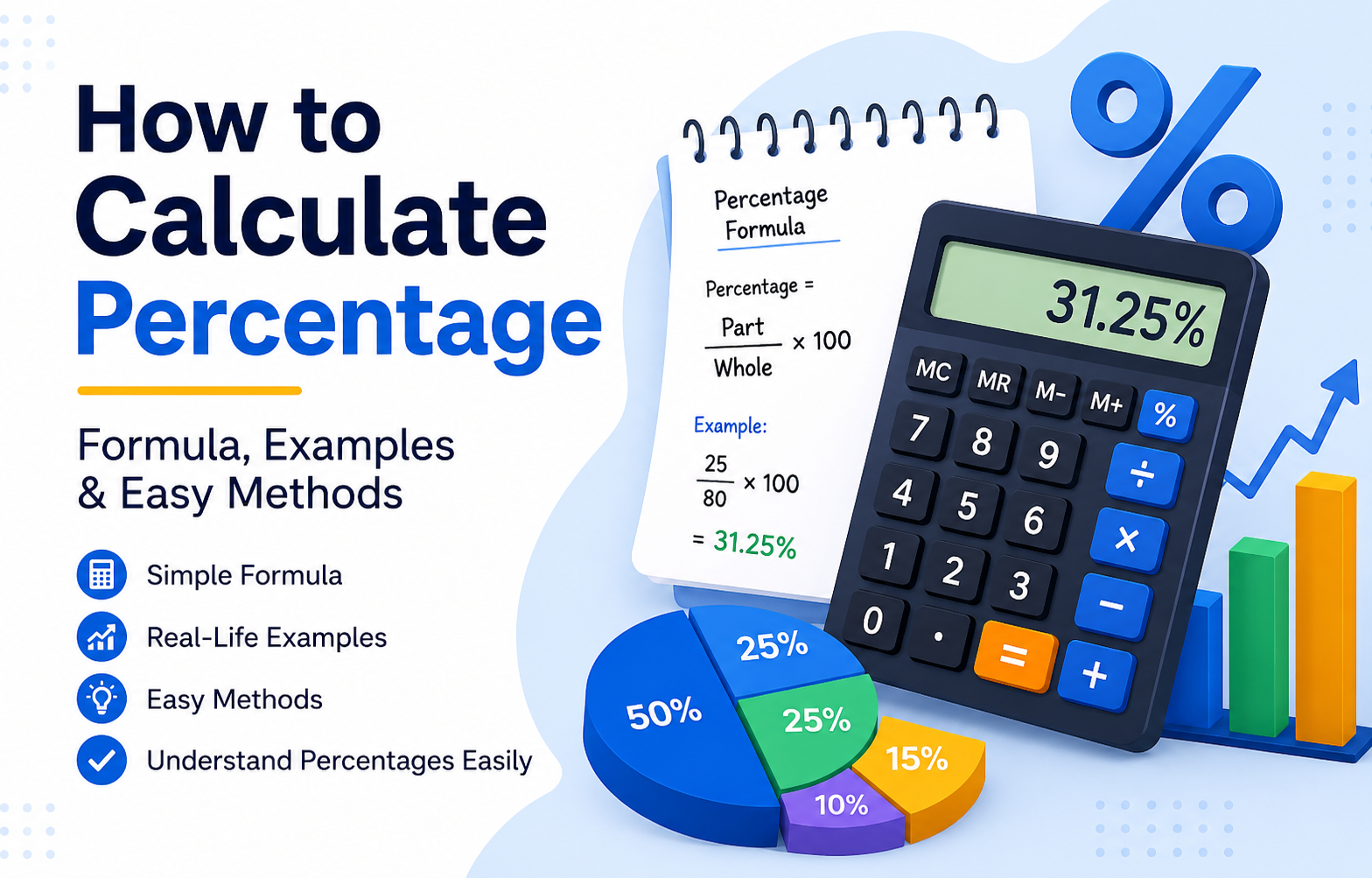
Percentage = (Part ÷ Whole) × 100
That’s really all there is to it. You take the part you’re interested in, divide it by the total, and multiply by 100 to turn it into a percentage.
Let’s try it with real numbers. Say you scored 18 out of 20 marks on a quiz.
- Part = 18
- Whole = 20
- Percentage = (18 ÷ 20) × 100 = 0.9 × 100 = 90%
You scored 90%. Simple as that.
Three Common Types of Percentage Problems
Most percentage questions in real life fall into one of three categories. Once you recognize which type you’re dealing with, the math becomes almost automatic.
1. Finding a Percentage of a Number
This is the classic “what is X% of Y” question. Say you want to know what 20% of 150 is.
Formula: (Percentage ÷ 100) × Number
(20 ÷ 100) × 150 = 0.2 × 150 = 30
So 20% of 150 is 30.
You’ll use this constantly — calculating a discount at a store, figuring out a tip, or working out how much tax you owe.
Example: A jacket costs $80 and is on sale for 25% off. How much do you save?
(25 ÷ 100) × 80 = 0.25 × 80 = $20
You save $20, so the jacket now costs $60.
2. Finding What Percentage One Number Is of Another
This is where you know two numbers and want to find the relationship between them as a percentage. It’s the same formula we started with.
Percentage = (Part ÷ Whole) × 100
Example: You have 45 apples, and 9 of them are rotten. What percentage of your apples are rotten?
(9 ÷ 45) × 100 = 0.2 × 100 = 20%
So 20% of your apples went bad. Time for a trip to the market.
3. Finding the Whole When You Know the Percentage
Sometimes you know a percentage and a part, but you need to figure out the total. This one trips people up the most, but it’s not hard once you see the pattern.
Formula: Whole = (Part ÷ Percentage) × 100
Example: You paid $30 in tax, and that was 15% of the total bill. What was the total bill?
Whole = (30 ÷ 15) × 100 = 2 × 100 = $200
So the total bill was $200.
Percentage Increase and Decrease
This is another one people run into all the time — figuring out how much something has gone up or down in percentage terms. Think salary raises, price hikes, population growth, or weight loss.
Formula: Percentage Change = [(New Value − Old Value) ÷ Old Value] × 100
If the answer is positive, it’s an increase. If it’s negative, it’s a decrease.
Example: Your rent went from $800 to $880 a month. What’s the percentage increase?
[(880 − 800) ÷ 800] × 100 = (80 ÷ 800) × 100 = 0.1 × 100 = 10%
Your rent went up by 10%. Ouch.
Example: A phone that cost $500 is now selling for $400. What’s the percentage decrease?
[(400 − 500) ÷ 500] × 100 = (−100 ÷ 500) × 100 = −20%
The price dropped by 20%.
How to Calculate Percentage in Different Situations
Not every percentage problem needs a calculator. Here are a few shortcuts that make life easier, especially when you’re out shopping or splitting a bill.
Finding 10% of anything: Just move the decimal point one place to the left. 10% of 250 is 25. 10% of 63 is 6.3. That’s it.
Finding 5%: Find 10% first, then cut it in half. 10% of 80 is 8, so 5% of 80 is 4.
Finding 20%: Find 10%, then double it. 10% of 90 is 9, so 20% of 90 is 18.
Finding 1%: Move the decimal point two places to the left. 1% of 500 is 5.
Combining these: Want 15% of 200? Find 10% (20) and 5% (10), then add them together: 20 + 10 = 30.
Once you get comfortable breaking numbers into 10%, 5%, and 1% chunks, you can build almost any percentage in your head within seconds.
Percentage in Everyday Life
It helps to see how often this shows up outside the classroom.
Shopping discounts: A store advertises “30% off.” Knowing the formula lets you instantly figure out your real savings instead of just trusting the sign.
Restaurant tips: Most people tip around 15-20% of the bill. If your bill is $60, a 20% tip means (20 ÷ 100) × 60 = $12.
Exam scores: Converting raw marks into a percentage lets you compare performance across subjects or tests with different total marks.
Interest rates: Whether it’s a savings account earning 4% annual interest or a loan charging 12%, understanding percentages helps you see exactly how much money is involved.
Body and health stats: Body fat percentage, weight loss goals, and even sleep-quality apps often report progress as percentages.
Statistics and news: Headlines love percentages — “unemployment rose by 2%,” “inflation hit 6% this year.” Understanding the math behind these numbers helps you actually understand the news instead of just skimming past it.
Common Mistakes to Avoid
A few small errors trip people up again and again, so it’s worth calling them out.
Mixing up part and whole. Always be clear about which number is the “part” and which is the “total.” Flipping them gives you a completely wrong answer.
Forgetting to convert the percentage to a decimal. When calculating a percentage of a number, remember to divide the percentage by 100 before multiplying. Skipping this step is probably the most common mistake there is.
Confusing percentage points with percentage change. If interest rates go from 5% to 7%, that’s a 2 percentage point increase, but it’s actually a 40% increase relative to the original rate [(7−5)/5 × 100]. These are two different things, and mixing them up can seriously distort your understanding of a situation.
Not double-checking with estimation. A quick sanity check goes a long way. If you calculate that 48% of 200 is 960, stop — that’s obviously wrong, since 48% of 200 should be less than 200 itself. A rough estimate before the exact calculation helps catch errors like this.
Final Thoughts
Percentages aren’t some mysterious math concept reserved for textbooks — they’re a practical tool you use almost every single day, whether you realize it or not. Once the core formula clicks — Part divided by Whole, times 100 — everything else, from discounts to tips to exam scores to salary raises, becomes a matter of plugging in the right numbers.
Practice with numbers you actually deal with in real life. Calculate the tip the next time you eat out. Work out the real price of that “40% off” item before you buy it. The more you use percentages in everyday situations, the more natural they’ll feel, until one day you realize you’re doing the math in your head without even thinking about it.
FAQS:
What is the basic formula for calculating a percentage?
What is the basic formula for calculating a percentage?
The basic percentage formula is:
Percentage = (Value ÷ Total Value) × 100
This formula helps determine what portion one number represents out of another.
How do I calculate the percentage increase?
To find a percentage increase, use this formula:
Percentage Increase = ((New Value – Original Value) ÷ Original Value) × 100
This method is commonly used to measure growth in prices, sales, or scores.
How do I calculate the percentage decrease?
The formula for percentage decrease is:
Percentage Decrease = ((Original Value – New Value) ÷ Original Value) × 100
It is useful for tracking reductions in expenses, discounts, or losses.
How can I calculate percentages quickly?
You can calculate percentages quickly by using simple formulas, mental math techniques, or an online Global Percentage Calculator. These tools save time and reduce calculation errors.
Why are percentages important in daily life?
Percentages are used in many everyday situations, including calculating discounts, exam results, tax rates, interest payments, and business performance. They make comparisons easier and help people understand data clearly.
Can a percentage be greater than 100%?
Yes, a percentage can be more than 100%. This usually happens when a value exceeds the original amount, such as sales growth of 150% or profits increasing beyond the starting value.
Conclusion
Percentages are one of the most useful mathematical concepts we use every day. Whether you are calculating exam scores, shopping discounts, business profits, tax amounts, or financial growth, understanding percentage formulas can make calculations much easier.
By learning the basic percentage formula and practicing simple methods, anyone can calculate percentages with confidence. While manual calculations help understand the concept, using a Global Percentage Calculator provides a faster, more accurate, and convenient way to solve percentage problems instantly.
By understanding how to calculate percentages, you can confidently solve problems related to discounts, exam scores, taxes, and financial calculations.
With the right approach and tools, percentage calculations become simple, practical, and easy to apply in everyday life.