Running a business is not just about making sales. What truly matters is how much money you keep after paying all your business expenses. That’s where the Net Profit Percentage Calculator becomes useful.
Whether you own a small business, sell products online, work as a freelancer, or simply want to understand your company’s financial health, calculating your net profit percentage helps you measure how efficiently your business generates profit. Net Profit Percentage Calculator
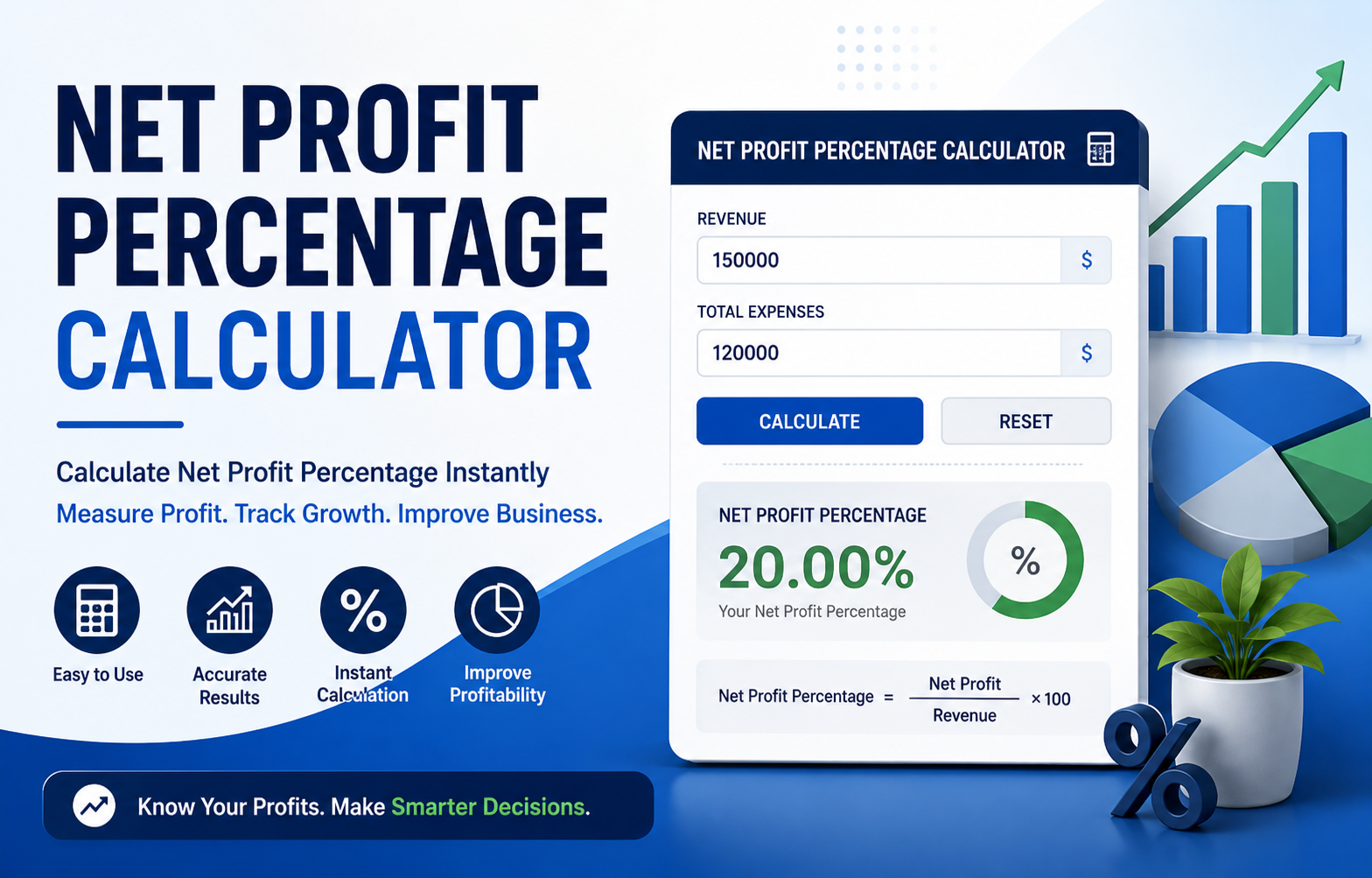
Our Net Profit Percentage Calculator makes this process quick and accurate. Simply enter your revenue and net profit, and the calculator instantly shows your net profit percentage.
In this guide, you’ll learn what net profit percentage means, how to calculate it, the formula, practical examples, common mistakes, and tips to improve your profitability.
Read more:Car Sales Tax Calculator Tennessee (TN) – Estimate Your Vehicle Tax Instantly
What Is Net Profit Percentage?
A higher net profit percentage generally means your business is managing its costs well and retaining more income from each sale. On the other hand, a lower percentage may indicate that operating expenses, taxes, or production costs are reducing your profits. Monitoring this figure regularly allows business owners to identify trends and make better financial decisions.
This metric is widely used by business owners, accountants, investors, and financial analysts to compare profitability over different periods or against competitors in the same industry. Whether you run a small local business or a large company, understanding your net profit percentage can help you evaluate growth and improve long-term success.
Many businesses calculate their net profit percentage monthly, quarterly, or annually as part of their financial reporting. Net Profit Percentage Calculator: Tracking this number consistently makes it easier to spot areas where costs can be reduced or revenue can be increased, ultimately helping improve overall profitability.
Net Profit Percentage Formula
The formula is simple.
Net Profit Percentage = (Net Profit ÷ Revenue) × 100
Where:
- Net Profit = Revenue − Total Expenses
- Revenue = Total sales before expenses
Example Formula
Revenue = $50,000
Net Profit = $8,500
Net Profit Percentage
= (8,500 ÷ 50,000) × 100
= 17%
This means the business earns 17 cents profit for every dollar of sales.
Use Our Net Profit Percentage Calculator
Our calculator removes the need for manual calculations and helps you determine your net profit percentage in just a few seconds. Instead of performing the formula yourself, simply enter your financial figures and let the calculator provide an accurate result instantly. It is easy to use, works on all devices, and is suitable for business owners, freelancers, students, and anyone who wants to measure profitability.
Simply enter:
- Total Revenue
- Net Profit
Then click Calculate to instantly receive:
- Net Profit Percentage
- Accurate results
- Fast calculation
- Easy-to-understand output
The calculator is free to use, mobile-friendly, and helps you save time while reducing the risk of calculation errors.
Click Calculate, and you’ll instantly receive:
- Net Profit Percentage based on the values you entered.
- Accurate Results using the correct net profit percentage formula.
- Fast Calculation without the need for manual calculations or complex spreadsheets.
- Easy-to-Understand Output that clearly shows your profitability.
- Time Savings by eliminating lengthy manual calculations.
- Error-Free Results that reduce the risk of common calculation mistakes.
- Instant Financial Insights to help you evaluate your business performance and make informed decisions.
- Mobile-Friendly Access, allowing you to calculate your net profit percentage anytime on desktop, tablet, or smartphone.
It works on mobile, tablet, and desktop devices.
Why is Net Profit Percentage used?
Net Profit Percentage is one of the most important financial metrics for businesses of all sizes. It helps you understand how efficiently your company turns revenue into actual profit after covering every expense. Unlike sales figures alone, this percentage gives a clearer picture of your overall financial performance. It shows how much of your total income remains as profit after paying for production, operating costs, taxes, and other business expenses. This makes it a valuable indicator of your company’s financial health.
A higher net profit percentage generally means your business is managing its costs well and retaining more income from each sale. On the other hand, a lower percentage may indicate that operating expenses, taxes, or production costs are reducing your profits. Monitoring this figure regularly allows business owners to identify trends and make better financial decisions. It can also help determine whether recent changes in pricing, expenses, or sales strategies are improving overall profitability.
This metric is widely used by business owners, accountants, investors, and financial analysts to compare profitability over different periods or against competitors in the same industry. Whether you run a small local business or a large company, understanding your net profit percentage can help you evaluate growth and improve long-term success. It also provides useful insights when preparing financial reports, applying for business loans, or attracting potential investors.
Many businesses calculate their net profit percentage monthly, quarterly, or annually as part of their financial reporting. Tracking this number consistently makes it easier to spot areas where costs can be reduced or revenue can be increased, ultimately helping improve overall profitability. Regular monitoring also allows businesses to set realistic financial goals, measure progress over time, and make informed decisions that support sustainable growth.
Read more:Percentage Margin Calculator – Calculate Business Margin Online (2026)How to Calculate Net Profit Percentage Step by Step
Follow these simple steps.
Step 1: Calculate Total Revenue
Add all income generated from sales.
Example:
Product Sales = $90,000
Service Income = $10,000
Total Revenue = $100,000
Step 2: Calculate Total Expenses
Add every business expense.
Example:
Cost of Goods = $45,000
Rent = $8,000
Salaries = $15,000
Marketing = $4,000
Utilities = $3,000
Taxes = $5,000
Total Expenses = $80,000
Step 3: Find Net Profit
Net Profit
= Revenue − Total Expenses
= $100,000 − $80,000
= $20,000
Step 4: Calculate Net Profit Percentage
(Net Profit ÷ Revenue) × 100
= (20,000 ÷ 100,000) × 100
= 20%
Your business has a 20% net profit margin.
Worked Examples
Example 1: Retail Store
Revenue = $60,000
Net Profit = $9,000
Calculation
(9,000 ÷ 60,000) × 100
= 15%
The retail business earns a 15% net profit.
Example 2: Restaurant
Revenue = $150,000
Net Profit = $18,000
Calculation
(18,000 ÷ 150,000) × 100
= 12%
The restaurant keeps 12% of its revenue as profit.
Example 3: Freelancer
Revenue = $5,000
Expenses = $1,200
Net Profit
= $5,000 − $1,200
= $3,800
Percentage
(3,800 ÷ 5,000) × 100
= 76%
The freelancer has a 76% profit margin.
Example 4: Manufacturing Business
Revenue = $500,000
Expenses = $430,000
Net Profit
= $70,000
Percentage
(70,000 ÷ 500,000) × 100
= 14%
Read more:Percentage Savings Calculator – Find Total Savings on Discounts (2026)Net Profit Percentage vs Gross Profit Percentage
Many people confuse these two financial terms.
| Net Profit Percentage | Gross Profit Percentage |
|---|---|
| Includes all business expenses | Only subtracts cost of goods sold |
| Shows final profitability | Shows product profitability |
| Used to measure overall business health | Used to measure production efficiency |
| More accurate for business analysis | Useful for pricing decisions |
Gross profit is calculated before operating expenses.
Net profit is calculated after every expense.
What Is a Good Net Profit Percentage?
There is no single perfect net profit percentage because every industry has different operating costs, pricing strategies, and profit expectations. For example, businesses with high operating expenses may have lower profit margins, while companies with lower costs often achieve higher percentages. The best way to evaluate your performance is to compare your net profit percentage with similar businesses in your industry and track your own results over time. Consistently improving your profit percentage is often a stronger indicator of financial health than aiming for a specific number.
General guideline:
| Net Profit Percentage | Meaning |
|---|---|
| Below 5% | Low profitability |
| 5%–10% | Average |
| 10%–20% | Good |
| Above 20% | Excellent |
Always compare your profit margin with businesses in the same industry.
Factors That Affect Net Profit Percentage
Many factors can influence your net profit margin. Understanding these factors helps you identify opportunities to increase profitability and make better financial decisions.
These include:
- Rising Operating Costs: Higher expenses for rent, utilities, or day-to-day operations can reduce your net profit.
- Product Pricing: Setting prices too low may increase sales but reduce overall profitability, while effective pricing can improve profit margins.
- Sales Volume: Selling more products or services generally increases revenue, provided expenses remain under control.
- Employee Wages: Salaries, bonuses, and other payroll costs directly affect your business expenses and net profit.
- Marketing Expenses: Advertising and promotional campaigns can increase sales, but excessive spending without sufficient returns may lower profits.
- Loan Interest: Interest payments on business loans increase total expenses and reduce net profit.
- Tax Rates: Higher taxes reduce the amount of profit your business retains after all obligations are paid.
- Inventory Management: Efficient inventory control helps prevent overstocking, shortages, and waste, improving profitability.
- Supplier Costs: Increases in raw material or supplier prices raise production costs and reduce profit margins.
- Business Efficiency: Streamlined operations, improved productivity, and effective cost management help lower expenses and increase net profit percentage.
Reducing unnecessary expenses often improves profit percentage.
How to Improve Net Profit Percentage
Businesses can increase profitability in several ways. Improving your net profit percentage often involves increasing revenue while keeping expenses under control. Even small operational changes can make a noticeable difference over time.
Some effective ways to improve your net profit percentage include:
Monitor your net profit percentage regularly to track business performance and make informed financial decisions.
Increase sales through effective marketing and customer retention.
Reduce unnecessary operating expenses and overhead costs.
Negotiate better prices and payment terms with suppliers.
Improve pricing strategies without reducing customer demand.
Manage inventory efficiently to minimize waste and storage costs.
Increase employee productivity through better workflows and training.
Review financial reports regularly to identify cost-saving opportunities.
Use automation and technology to improve efficiency and reduce manual work.
Focus on high-margin products or services that generate greater profits.
Increase Sales
Higher revenue often increases profits if expenses remain controlled. Businesses can boost sales by attracting new customers, improving marketing strategies, expanding their product or service range, and encouraging repeat purchases from existing customers. Even a small increase in sales can significantly improve your net profit percentage when costs are managed effectively.
Reduce Operating Costs
Review your monthly expenses to understand where your money is being spent and identify areas where costs can be reduced. Cut unnecessary spending, eliminate waste, and look for more cost-effective alternatives without affecting the quality of your products or services. Even small reductions in operating costs can significantly improve your net profit percentage over time.
Improve Pricing
Charging slightly higher prices can improve profit margins without significantly affecting demand. Review your pricing strategy regularly to ensure it reflects your costs, product value, and current market conditions. Even a small price increase on high-demand products or services can boost profitability, provided customers continue to see value in what you offer.
Negotiate with Suppliers
Lower purchasing costs directly increase profits. Build strong relationships with suppliers and negotiate better prices, bulk discounts, or more favorable payment terms whenever possible. Even small reductions in material or inventory costs can improve your net profit percentage over time without increasing your selling prices.
Reduce Waste
Managing inventory efficiently prevents unnecessary losses. Regularly monitor stock levels, reduce excess inventory, and minimize damaged or unused materials. Improving production processes and avoiding unnecessary spending can lower operating costs, helping your business increase profitability and achieve a higher net profit percentage over time.
Increase Productivity
Better workflows help employees complete more work with fewer resources. Streamline daily operations, automate repetitive tasks where possible, and provide employees with the right tools and training to improve efficiency. Higher productivity helps reduce operating costs, increase output, and improve your net profit percentage without significantly increasing business expenses.
Monitor Expenses Regularly
Review financial reports every month to identify unnecessary spending and monitor changes in your business costs. Tracking expenses consistently helps you spot financial issues early, improve budgeting, and make informed decisions. Even small savings made over time can add up, increasing your net profit percentage and strengthening your business’s overall financial performance.
Common Mistakes When Calculating Net Profit Percentage
Many beginners make simple calculation errors.
Common mistakes include:
- Using gross profit instead of net profit
- Forgetting taxes
- Ignoring loan interest
- Excluding operating expenses
- Using incorrect revenue figures
- Mixing monthly and yearly data
- Entering inaccurate financial information
Using an online calculator reduces these errors.
Who Should Use a Net Profit Percentage Calculator?
This calculator is useful for many people.
Including:
- Small business owners
- Retail stores
- Restaurant owners
- Online sellers
- Amazon sellers
- Shopify store owners
- Freelancers
- Consultants
- Startups
- Investors
- Accountants
- Students studying business
- Financial analysts
Anyone wanting to understand profitability can benefit from this calculation.
Benefits of Using an Online Calculator
Manual calculations can take time and may lead to mistakes, especially when working with large financial figures. An online calculator simplifies the process by providing instant and reliable results. Whether you’re a business owner, freelancer, student, or accountant, it helps you calculate your net profit percentage quickly and confidently.
Our calculator offers several advantages:
- Instant Results: Get your net profit percentage in seconds.
- Accurate Calculations: Reduces the risk of manual calculation errors.
- Easy to Use: Simply enter your revenue and net profit values.
- No Mathematical Knowledge Required: Anyone can use the calculator without understanding complex formulas.
- Mobile-Friendly: Access and use the calculator on your phone, tablet, or desktop.
- Saves Time: Complete calculations much faster than doing them manually.
- Free to Use: No registration, downloads, or hidden charges.
- Perfect for Business Planning: Monitor profitability, compare performance, and make informed financial decisions with ease.
Real-Life Example
Imagine a clothing business.
Annual Revenue = $300,000
Expenses:
- Inventory = $140,000
- Salaries = $60,000
- Rent = $20,000
- Marketing = $15,000
- Utilities = $5,000
- Taxes = $10,000
Total Expenses
= $250,000
Net Profit
= $300,000 − $250,000
= $50,000
Net Profit Percentage
(50,000 ÷ 300,000) × 100
= 16.67%
This means the company keeps around 17% of every sales dollar as profit.
Tips for Better Profitability
Successful businesses regularly monitor their profit margin.
Here are a few practical tips:
- Review expenses every month.
- Increase operational efficiency.
- Focus on high-profit products.
- Eliminate unnecessary costs.
- Improve customer retention.
- Track financial performance consistently.
- Reassess pricing strategies.
- Use accounting software for accurate records.
Small improvements over time can significantly increase your net profit percentage:
Frequently Asked Questions (FAQs)
What is net profit percentage?
Net profit percentage is the percentage of revenue that remains after subtracting all business expenses, including operating costs, taxes, and interest.
Is net profit the same as gross profit?
No. Gross profit only deducts the cost of goods sold, while net profit deducts all business expenses.
Why is net profit percentage important?
It helps measure the overall financial health and profitability of a business, making it easier to evaluate performance and make informed decisions.
Can net profit percentage be negative?
Yes. If total expenses are greater than revenue, the business has a net loss, resulting in a negative net profit percentage.
What is considered a good net profit percentage?
It depends on the industry, but a margin between 10% and 20% is generally considered healthy for many businesses.
How often should I calculate net profit percentage?
Most businesses calculate it monthly, quarterly, and annually to monitor performance and identify trends.
Can startups use this calculator?
Yes. Startups can use it to track profitability, control expenses, and improve financial planning from the early stages.
Conclusion
Knowing your Net Profit Percentage is one of the simplest ways to understand how profitable your business really is. While sales show how much money comes in, net profit percentage reveals how much you actually keep after paying all expenses.
Using a Net Profit Percentage Calculator saves time, reduces calculation errors, and provides instant, accurate results. Whether you’re a small business owner, freelancer, student, or financial professional, regularly tracking your net profit percentage helps you make smarter financial decisions, control costs, and improve long-term business performance. By monitoring this key metric consistently, you can identify opportunities to increase profitability and build a stronger, more sustainable business.