Percentage Ratio Calculator – Convert Ratios into Percentages
Have you ever seen a ratio like 3:5, 2:7, or 18:25 and wondered what it means as a percentage? You’re not alone. Ratios are used in school, business, finance, sports, cooking, and many other areas of everyday life. However, percentages are often easier to understand because they show a value out of 100.
A Percentage Ratio Calculator makes this conversion quick and accurate. Instead of calculating everything by hand, you simply enter the ratio, and the calculator instantly converts it into percentages.
In this guide, you’ll learn what ratio percentages are, how to calculate them manually, the formulas involved, practical examples, common mistakes, and why an online calculator is the easiest solution.
Visit Now::Salary and Tax Estimator USA
What Is a Ratio?
A ratio compares two or more quantities.
For example:
- 1:2 means 1 part compared to 2 parts.
- 3:5 means 3 compared to 5.
- 7:8 compares seven units with eight units.
Ratios do not automatically represent percentages because they compare values rather than showing parts of a whole.
For example:
Ratio = 3:5
This means:
- First value = 3
- Second value = 5
- Total = 8
Now each part can be expressed as a percentage of the total.
Read More:Exam Percentage CalculatorWhat Is a Percentage?
A percentage represents a number out of 100.
Examples:
- 25% means 25 out of 100.
- 50% means half.
- 75% means three-quarters.
- 100% means the complete amount.
What Is a Percentage Ratio Calculator?
A Percentage Ratio Calculator converts every part of a ratio into its percentage of the total.
Instead of manually adding numbers and dividing each value, the calculator performs all calculations instantly.
For example:
Ratio:
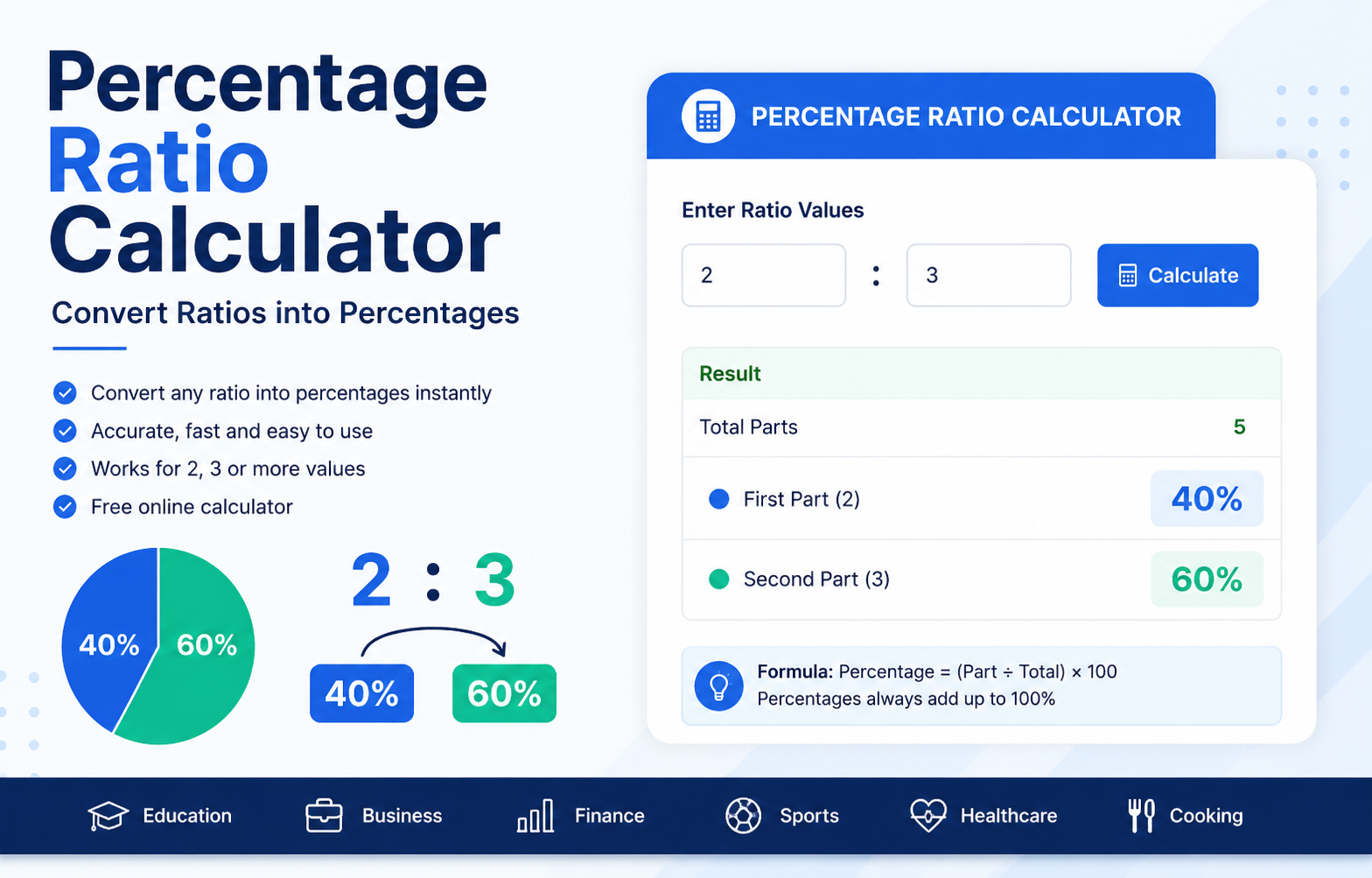
2 : 3
Result:
- First part = 40%
- Second part = 60%
This is especially useful for:
- Students
- Teachers
- Business owners
- Financial analysts
- Data researchers
- Sports coaches
- Engineers
Formula to Convert Ratio into Percentage
The calculation is straightforward.
Step 1: Add all parts of the ratio.
Total = Sum of all values
Step 2: Divide each value by the total.
Step 3: Multiply by 100.
Formula:
Percentage = (Ratio Part ÷ Total Ratio) × 100
Example 1
Ratio:
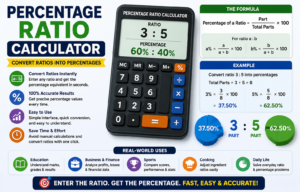
3: 5
Step 1:
Total = 3 + 5 = 8
Step 2:
First Percentage
= (3 ÷ 8) × 100
= 37.5%
Second Percentage
= (5 ÷ 8) × 100
= 62.5%
Result:
- 3 = 37.5%
- 5 = 62.5%
Example 2
Ratio:
4: 6
Total
4 + 6 = 10
First
4 ÷ 10 × 100 = 40%
Second
6 ÷ 10 × 100 = 60%
Example 3
Ratio:
7: 13
Total
20
First
7 ÷ 20 × 100 = 35%
Second
13 ÷ 20 × 100 = 65%
Example 4
Ratio:
15: 25
Total
40
First
15 ÷ 40 × 100 = 37.5%
Second
25 ÷ 40 × 100 = 62.5%
Example 5
Ratio:
8: 12
Total
20
First
8 ÷ 20 × 100 = 40%
Second
12 ÷ 20 × 100 = 60%
Ratio to Percentage Conversion Table
| Ratio | First Part | Second Part |
|---|---|---|
| 1: 1 | 50% | 50% |
| 1: 2 | 33.33% | 66.67% |
| 2 : 3 | 40% | 60% |
| 3: 4 | 42.86% | 57.14% |
| 4 : 5 | 44.44% | 55.56% |
| 5: 6 | 45.45% | 54.55% |
| 3: 5 | 37.5% | 62.5% |
| 7: 8 | 46.67% | 53.33% |
| 9 : 11 | 45% | 55% |
| 2 : 5 | 28.57% | 71.43% |
How to Use the Percentage Ratio Calculator
Using the calculator is simple.
Step 1
Enter the first ratio value.
Example:
12
Step 2
Enter the second ratio value.
Example:
18
Step 3
Click Calculate.
The calculator instantly shows:
- Total
- First percentage
- Second percentage
Some calculators also support three or more values.
Example:
2: 4: 6
Results:
- 16.67%
- 33.33%
- 50%
Why Convert Ratios into Percentages?
Percentages are easier for most people to understand.
Instead of saying:
“The ratio is 7:13”
You can say:
- 35%
- 65%
This makes reports, presentations, and comparisons much clearer.
Real-Life Uses
Education
Teachers often compare:
- Boys vs girls
- Passed vs failed students
- Attendance records
- Grade distributions
Percentages make school reports easier to understand.
Business
Companies compare:
- Sales by department
- Product performance
- Revenue sources
- Marketing campaigns
Ratios converted into percentages provide clearer business insights.
Finance
Financial experts use ratios for:
- Investments
- Expenses
- Income
- Profit distribution
Converting ratios into percentages simplifies financial analysis.
Sports
Sports statistics often compare:
- Wins vs losses
- Possession
- Goals scored
- Player performance
Percentages are commonly used in scorecards and reports.
Healthcare
Hospitals compare:
- Male vs female patients
- Recovery rates
- Vaccination numbers
- Disease statistics
Percentages make medical data easier to interpret.
Cooking
Recipes often use ingredient ratios.
Converting them into percentages helps when adjusting recipe sizes while maintaining the correct proportions.
Advantages of Using a Percentage Ratio Calculator
Saves Time
Results are available instantly.
Accurate
No manual calculation mistakes.
Easy to Use
Anyone can calculate percentages without advanced math skills.
Works for Large Ratios
Handles large numbers easily.
Free Online
Most percentage ratio calculators are available online at no cost.
Manual Calculation Example
Suppose the ratio is:
18: 22
Step 1
Total
18 + 22 = 40
Step 2
First
18 ÷ 40 × 100
= 45%
Second
22 ÷ 40 × 100
= 55%
Final Answer
18:22
=
45%
55%
Three-Part Ratio Example
Ratio:
2 : 3: 5
Total
2 + 3 + 5 = 10
First
2 ÷ 10 × 100
= 20%
Second
3 ÷ 10 × 100
= 30%
Third
5 ÷ 10 × 100
= 50%
Result:
- 20%
- 30%
- 50%
Four-Part Ratio Example
Ratio
5 : 10: 15: 20
Total
50
Percentages
5 = 10%
10 = 20%
15 = 30%
20 = 40%
Total
100%
Common Mistakes
Forgetting to Add All Values
Always calculate the total before dividing.
Incorrect:
3 ÷ 5
Correct:
3 ÷ (3 + 5)
Multiplying Too Early
Always divide first, then multiply by 100.
Ignoring Decimal Values
Many ratios produce decimal percentages.
Example:
3: 7
Results:
30%
70%
Rounding Incorrectly
For better accuracy, keep two decimal places when necessary.
Example:
33.33%
instead of
33%
Tips for Accurate Calculations
- Double-check the ratio values.
- Add all parts before dividing.
- Use decimal precision when needed.
- Verify that all percentages add up to 100%.
- Use an online calculator for quick results.
Ratio vs Percentage
| Ratio | Percentage |
|---|---|
| Compares quantities | Shows part out of 100 |
| Written as 2:3 | Written as 40% |
| Useful for comparisons | Easier to understand |
| May contain multiple values | Always expressed out of 100 |
| Used in mathematics | Used in reports and statistics |
Frequently Asked Questions
Can every ratio be converted into percentages?
Yes. Every ratio can be converted into percentages by dividing each part by the total and multiplying by 100.
Can ratios have more than two numbers?
Yes.
Examples:
2:3:5
4:7:9
5:8:12
The same calculation method applies.
Why don’t percentages always come out as whole numbers?
Some ratios produce decimal results.
Example:
1:2
Results:
33.33%
66.67%
Should all percentages add up to 100%?
Yes.
If you’ve calculated correctly, the percentages of all ratio parts should always total 100%.
Is an online calculator better than manual calculation?
Yes. It saves time, reduces errors, and provides instant, accurate results—especially for complex or multi-part ratios.
Final Thoughts
A Percentage Ratio Calculator is a simple yet powerful tool that helps convert ratios into easy-to-understand percentages. Whether you’re a student solving math problems, a teacher preparing reports, a business owner analyzing sales, or simply comparing values in everyday life, converting ratios to percentages makes data much clearer.
While the manual method is useful for learning, an online calculator offers speed, accuracy, and convenience. Just enter your ratio values, click calculate, and instantly see each part expressed as a percentage of the whole. Understanding this basic concept can make interpreting data, creating reports, and making informed decisions much easier in both academic and professional settings.