Percentages are everywhere. We use them to measure exam scores, discounts, profits, taxes, attendance, and many other everyday calculations. However, there are times when expressing a percentage as a ratio makes more sense, especially in mathematics, statistics, finance, engineering, and data analysis.
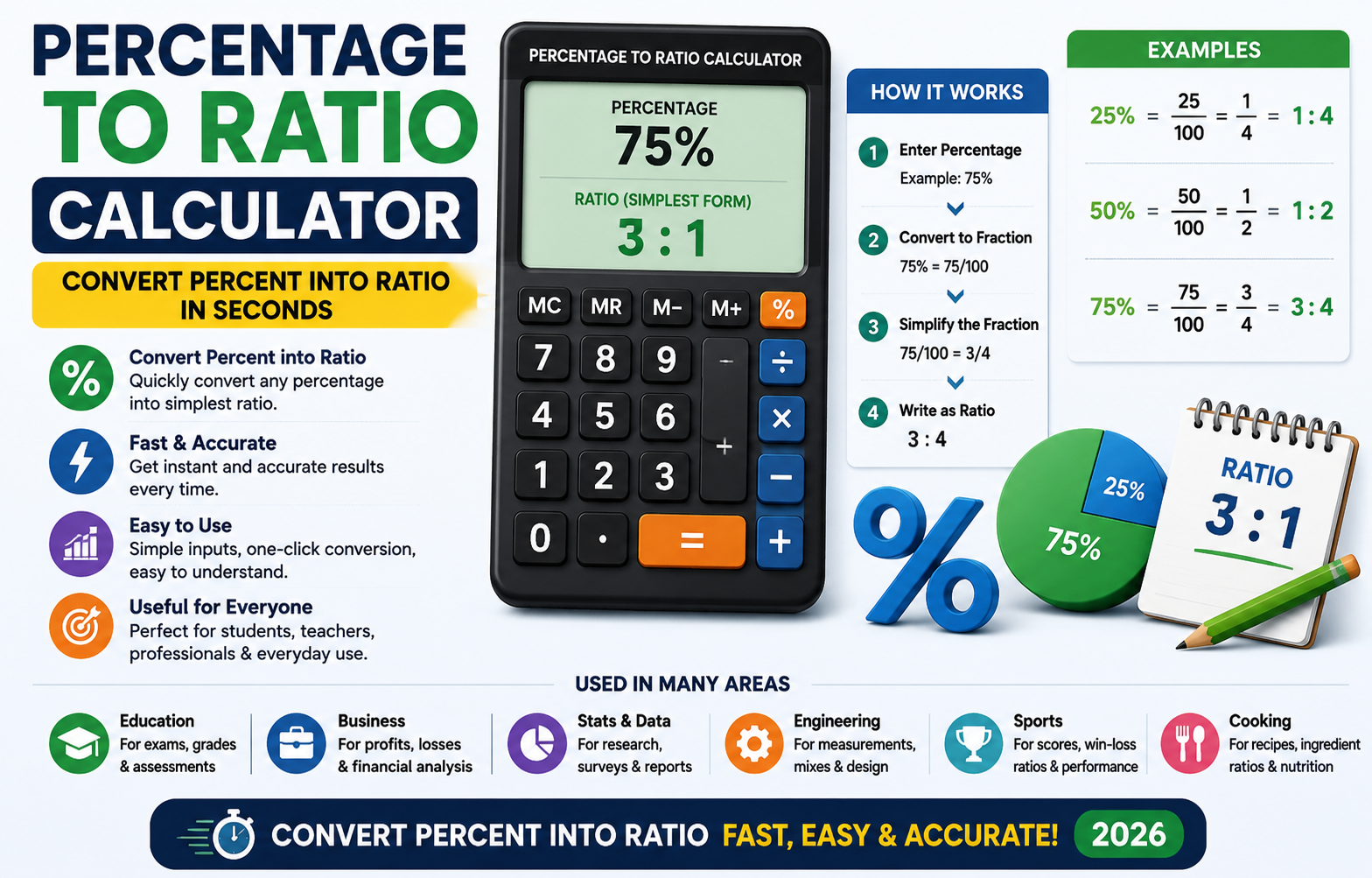
For example, if 25% of students in a class play football, you can also express this as the ratio 1:4. Likewise, 50% can be written as 1:2, and 75% becomes 3:4. Ratios make it easier to compare quantities and understand proportions.
A Percentage to Ratio Calculator helps you convert any percentage into its simplest ratio within seconds. Instead of solving fractions manually, simply enter the percentage, and the calculator instantly displays the equivalent ratio.
In this guide, you’ll learn what percentages and ratios are, how to convert percentages into ratios, the formula involved, practical examples, real-life applications, common mistakes, and why using an online calculator is the fastest and easiest solution.
Visit Now:Salary and Tax Estimator USA
What Is a Percentage?
A percentage is a number expressed as a fraction of 100. It is one of the easiest ways to compare values because every percentage is measured on the same scale—out of 100.
The word “percent” literally means “per hundred.” The symbol % is used to represent a percentage.
For example:
- 10% means 10 out of 100.
- 25% means 25 out of 100.
- 50% means half or 50 out of 100.
- 75% means three-quarters or 75 out of 100.
- 100% means the complete amount or the whole.
Percentages are widely used in everyday life because they make numbers easier to understand and compare. Whether you’re checking your exam results, calculating a shopping discount, measuring business profits, or tracking investment returns, percentages provide a simple way to express parts of a whole.
For example, if you scored 90 marks out of 100, your percentage is 90%. Similarly, if a store offers a 20% discount on a product, it means the price has been reduced by 20 out of every 100 units of its original value.
Because percentages are easy to read and compare, they are commonly used in education, finance, business, healthcare, sports, statistics, and many other fields around the world.
Percentages are widely used because they make comparisons easy.
Read More:Percentage CalculatorWhat Is a Ratio?
A ratio is a way of comparing two or more quantities. It shows the relationship between different values and helps us understand how one quantity relates to another. Ratios are usually written with a colon (:) between the numbers, although they can also be written as fractions.
Examples include:
- 1:2
- 2:3
- 3:5
- 4:7
For example, if there are 10 boys and 20 girls in a classroom, the ratio of boys to girls is 10:20, which can be simplified to 1:2. This means there is 1 boy for every 2 girls.
Ratios are commonly used in everyday life to compare quantities, such as ingredients in a recipe, wins and losses in sports, classroom statistics, financial data, map scales, and business reports. They help us see the proportion between values without referring to a total.
Unlike percentages, ratios do not show values out of 100. Instead, they simply compare one quantity with another. In many situations, converting a ratio into a percentage makes the information easier to understand and compare, which is why tools like a Percentage to Ratio Calculator and Ratio to Percentage Calculator are so useful.
What Is a Percentage to Ratio Calculator?
A Percentage to Ratio Calculator is an online tool that converts a percentage into its simplest ratio.
For example:
- 50% = 1:2
- 25% = 1:4
- 75% = 3:4
- 20% = 1:5
Instead of calculating fractions and simplifying ratios manually, the calculator does everything instantly.
Percentage to Ratio Formula
The conversion process is simple.
Step 1
Write the percentage as a fraction over 100.
Percentage ÷ 100
Step 2
Simplify the fraction.
Step 3
Convert the simplified fraction into ratio form.
Ratio = Numerator: Denominator
Formula
Ratio = Percentage : (100 − Percentage)
This formula is commonly used when expressing a percentage as the ratio of a part to the remaining part.
If you want the ratio of the percentage to the whole, first convert the percentage into a fraction and simplify.
Read More:Loss Percentage CalculatorHow to Convert a Percentage to a Ratio
Let’s look at a few examples.
Example 1
Convert 25% into a ratio.
Step 1
25%
= 25/100
Step 2
Simplify.
25 ÷ 25 = 1
100 ÷ 25 = 4
Step 3
Ratio:
1:4
Example 2
Convert 50% into a ratio.
50/100
Simplify.
1/2
Ratio:
1:2
Example 3
Convert 75% into a ratio.
75/100
Simplify.
3/4
Ratio:
3:4
Example 4
Convert 20% into a ratio.
20/100
Simplify.
1/5
Ratio:
1:5
Example 5
Convert 40% into a ratio.
40/100
Simplify.
2/5
Ratio:
2:5
Percentage to Ratio Conversion Table
| Percentage | Ratio |
|---|---|
| 10% | 1:10 |
| 20% | 1:5 |
| 25% | 1:4 |
| 30% | 3:10 |
| 40% | 2:5 |
| 50% | 1:2 |
| 60% | 3:5 |
| 70% | 7:10 |
| 75% | 3:4 |
| 80% | 4:5 |
| 90% | 9:10 |
| 100% | 1:1 |
How to Use a Percentage to Ratio Calculator
Using the calculator is very easy.
Step 1
Enter the percentage.
Example:
60%
Step 2
Click Calculate.
Step 3
The calculator instantly displays:
- Simplified ratio
- Fraction
- Decimal value (if applicable)
The entire calculation takes only a few seconds.
Why Convert a Percentage into a Ratio?
Converting a percentage into a ratio makes it easier to compare quantities and understand the relationship between values. While percentages show a value out of 100, ratios compare one quantity directly with another. In many fields, a Percentage to Ratio Calculator helps present data more clearly and simplifies calculations.
For example, instead of saying:
“The success rate is 80%.”
You can express it as:
“The success ratio is 4:5.”
Both statements represent the same information, but the ratio clearly shows that 4 out of every 5 attempts were successful.
Converting percentages into ratios is especially useful in mathematics, engineering, finance, science, business, and statistics. Ratios are commonly used to compare ingredients in recipes, analyze financial performance, measure business growth, evaluate sports statistics, and present research data. Using a ratio can make comparisons more meaningful, especially when you’re working with proportions or comparing two quantities directly.
If you need quick and accurate results, a Percentage to Ratio Calculator can instantly convert any percentage into its simplest ratio without requiring manual calculations. Using an online Percentage to Ratio Calculator also helps reduce errors and saves time, especially when working with decimal percentages or large values.
Real-Life Uses of Percentage to Ratio
Education
Students convert percentages into ratios when solving mathematics questions.
Teachers also use ratios in:
- Classroom statistics
- Attendance reports
- Exam analysis
Business
Businesses compare:
- Sales performance
- Profit distribution
- Customer demographics
- Revenue sources
Ratios help visualize business data more effectively.
Finance
Financial analysts convert percentages into ratios when evaluating:
- Investment allocations
- Expense ratios
- Debt ratios
- Financial statements
Sports
Sports statistics frequently use ratios.
Examples include:
- Win ratios
- Goal ratios
- Shot accuracy
- Possession statistics
Percentages are often converted into ratios for deeper analysis.
Engineering
Engineers use ratios when working with:
- Material mixtures
- Design proportions
- Scale drawings
- Mechanical systems
Healthcare
Medical researchers compare:
- Recovery rates
- Patient groups
- Treatment effectiveness
- Disease statistics
Ratios simplify data interpretation.
Benefits of Using a Percentage to Ratio Calculator
Using a Percentage to Ratio Calculator provides many advantages.
Saves Time
Calculations are completed instantly.
Improves Accuracy
Reduces manual calculation errors.
Easy to Use
No advanced mathematics is required.
Simplifies Large Numbers
The calculator automatically reduces ratios to their simplest form.
Free Online
Most calculators are available online and work on desktops, tablets, and smartphones.
Manual Calculation Example
Suppose you want to convert 45% into a ratio.
Step 1
45%
= 45/100
Step 2
Simplify.
Divide both numbers by 5.
45 ÷ 5 = 9
100 ÷ 5 = 20
Step 3
Ratio:
9:20
Decimal Percentage Example
Convert 12.5% into a ratio.
12.5/100
Multiply both numbers by 10.
125/1000
Simplify.
1/8
Ratio:
1:8
Common Mistakes
Forgetting to Simplify
Incorrect:
25%
= 25:100
Correct:
1:4
Always reduce the ratio to its simplest form.
Confusing Ratio Types
A percentage can represent:
- Part to whole
- Part to remaining part
Choose the correct method depending on the question.
Ignoring Decimal Percentages
Decimal percentages should also be simplified properly.
For example:
62.5%
= 625/1000
= 5/8
Ratio:
5:8
Rounding Too Early
Avoid rounding before simplifying the fraction.
This improves accuracy.
Tips for Accurate Calculations
- Convert the percentage into a fraction first.
- Always simplify the fraction completely.
- Check your final ratio.
- Use an online calculator for quick results.
- Verify your answer if working with decimal percentages.
Percentage vs Ratio
| Percentage | Ratio |
|---|---|
| Expressed out of 100 | Compares quantities |
| Written with % | Written using : |
| Easy to understand | Useful for comparisons |
| Common in reports | Common in mathematics |
| Shows part of a whole | Shows relationships |
Frequently Asked Questions
What is a Percentage to Ratio Calculator?
A Percentage to Ratio Calculator converts any percentage into its simplest ratio.
How do you convert a percentage into a ratio?
Convert the percentage into a fraction over 100, simplify it, and write the result as a ratio.
Can decimal percentages be converted into ratios?
Yes. Decimal percentages such as 12.5% or 62.5% can also be converted by simplifying the fraction.
Why should I simplify the ratio?
Simplifying the ratio makes it easier to understand and compare values.
Is an online calculator better than manual calculation?
Yes. It saves time, reduces errors, and instantly converts percentages into simplified ratios.
Conclusion
A Percentage to Ratio Calculator is a useful tool for converting percentages into simple, easy-to-read ratios. Whether you’re solving math problems, preparing business reports, analyzing financial data, or comparing statistics, ratios often provide a clearer way to express relationships between values.
Although learning the manual conversion method helps you understand the concept, an online calculator is the fastest and most accurate option. Simply enter your percentage, click calculate, and instantly receive the simplified ratio. By understanding how to convert percentages into ratios, you’ll be better equipped to interpret data, solve mathematical problems, and communicate information clearly in both academic and professional settings.