Have you ever noticed that the price of groceries seems higher than last year? Or perhaps your salary increased, your business revenue changed, or your exam scores improved over time.
In all these situations, understanding percentage change helps you see exactly how much something has increased or decreased.
Instead of simply comparing two numbers, percentage change shows the size of the change relative to the original value. This makes comparisons easier and provides a clearer picture of growth or decline.
A Percentage Change Calculator helps simplify these calculations by instantly showing the percentage increase or decrease between two values.
Whether you’re a student, business owner, investor, teacher, or simply someone managing personal finances, understanding percentage change is an important skill.
In this guide, we’ll explain what percentage change means, how to calculate it manually, practical examples, and why using a Percentage Change
A calculator is often the fastest solution.
Visit Now::Salary and Tax Estimator USA
What Is Percentage Change?
Percentage change measures how much a value has increased or decreased compared to its original amount.
It tells us the relative difference between two numbers.
Percentage change is commonly used to track:
- Sales growth
- Business performance
- Exam results
- Population changes
- Investment returns
- Product prices
- Salary increases
- Weight loss progress
For example:
A product costs $100 this year and $120 next year.
Although the numerical difference is $20, the percentage change tells us the increase is actually 20%.
This makes it easier to understand the true size of the change.
Read More:Percentage of a Number CalculatorPercentage Change Formula
The standard percentage change formula is:
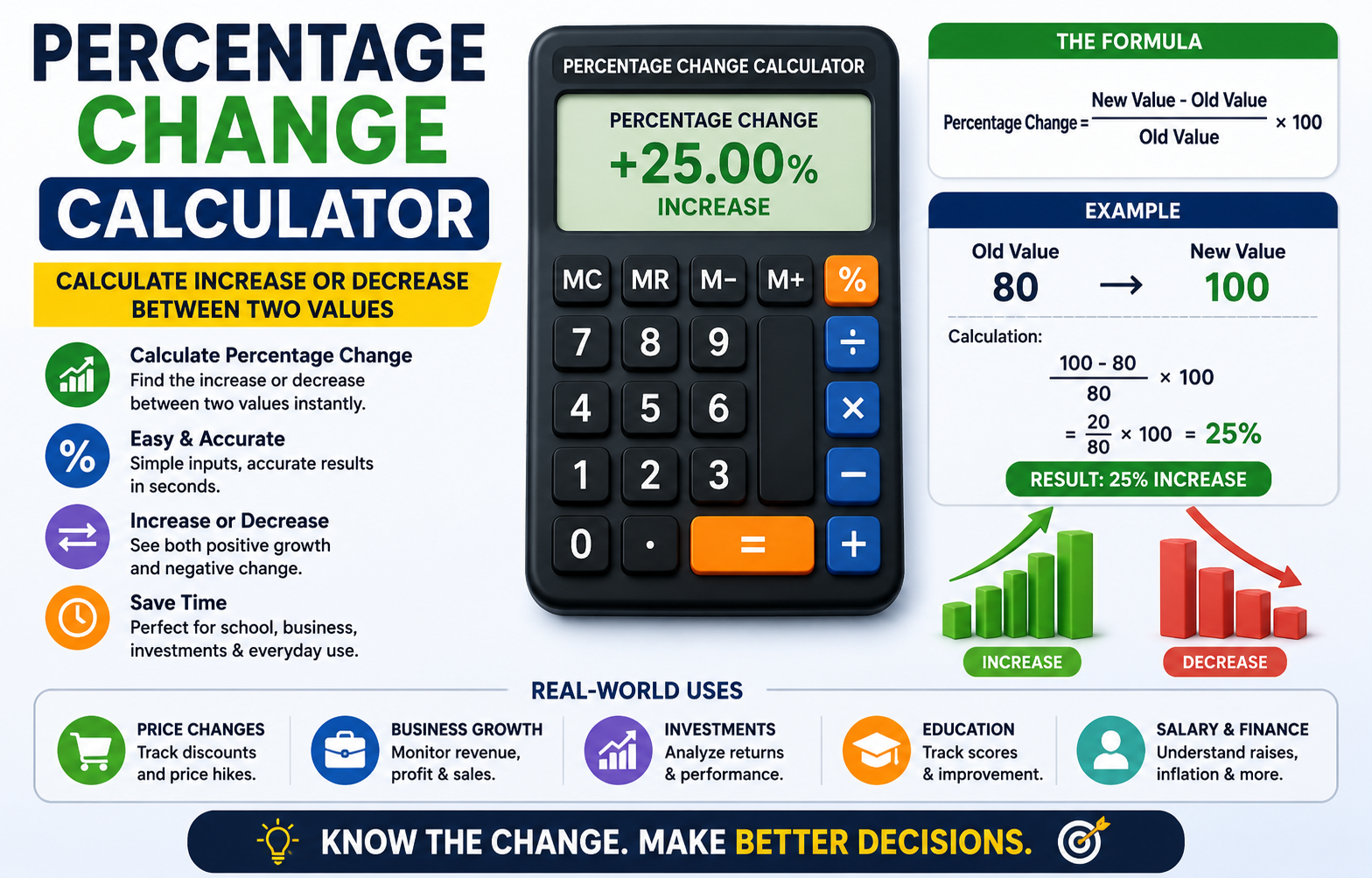
Percentage Change = ((New Value − Original Value) ÷ Original Value) × 100
The result can be:
- Positive → Percentage Increase
- Negative → Percentage Decrease
This formula works for almost every percentage change problem.
Understanding the Formula
Let’s break the formula into simple steps.
Step 1: Find the Difference
Subtract the original value from the new value.
Difference:
New Value − Original Value
Step 2: Divide by the Original Value
Take the difference and divide it by the original amount.
Step 3: Multiply by 100
Multiply the result by 100 to convert it into a percentage.
The final answer tells you the percentage increase or decrease.
How to Calculate Percentage Change Step by Step
Suppose a company’s monthly sales increased from $5,000 to $6,500.
Step 1: Find the Difference
6,500 − 5,000 = 1,500
Step 2: Divide by the Original Value
1,500 ÷ 5,000 = 0.30
Step 3: Multiply by 100
0.30 × 100 = 30%
Answer
Sales increased by 30%.
Percentage Change Calculator
A Percentage Change Calculator makes calculations much easier.
Simply enter:
- Original value
- New value
The calculator instantly provides:
- Percentage increase
- Percentage decrease
- Numerical difference
- Accurate results
- Instant calculations
There is no need to memorize formulas or solve equations manually.
Read More:How to Calculate Percentage:Percentage Increase Example
Suppose a student’s score improved from 70 to 84.
Step 1: Difference
84 − 70 = 14
Step 2: Divide by Original Value
14 ÷ 70 = 0.20
Step 3: Multiply by 100
0.20 × 100 = 20%
Result
The student’s score increased by 20%.
Percentage Decrease Example
A phone originally costs $900.
Later, the price drops to $720.
Step 1: Difference
720 − 900 = -180
Step 2: Divide by Original Value
-180 ÷ 900 = -0.20
Step 3: Multiply by 100
-0.20 × 100 = -20%
Result
The phone price decreased by 20%.
Percentage Change Calculator Examples
Examples help make concepts easier to understand.
Example 1: Salary Increase
Old Salary:
$3,000
New Salary:
$3,600
Difference:
600
Percentage Change:
(600 ÷ 3,000) × 100
= 20%
Salary increased by 20%.
Example 2: Population Growth
Population Last Year:
40,000
Population This Year:
44,000
Difference:
4,000
Percentage Change:
(4,000 ÷ 40,000) × 100
= 10%
Population increased by 10%.
Example 3: Price Reduction
Original Price:
$250
New Price:
$200
Difference:
-50
Percentage Change:
(-50 ÷ 250) × 100
= -20%
Price decreased by 20%.
Example 4: Business Revenue
Previous Revenue:
$80,000
Current Revenue:
$92,000
Difference:
12,000
Percentage Change:
(12,000 ÷ 80,000) × 100
= 15%
Revenue increased by 15%.
Percentage Increase vs Percentage Decrease
Percentage change can indicate either growth or decline.
Percentage Increase
Used when values rise over time.
Examples:
- Salary raises
- Business growth
- Sales improvement
- Population increases
Example:
Sales increased from $2,000 to $2,400.
Percentage increase:
20%
Percentage Decrease
Used when values decline.
Examples:
- Price reductions
- Revenue losses
- Population decline
- Expense reduction
Example:
Expenses dropped from $1,000 to $800.
Percentage decrease:
20%
Percentage Change vs Percentage Difference
People often confuse percentage change with percentage difference.
However, they are not the same.
Percentage Change
Uses an original value as the reference point.
Example:
80 increased to 100
Percentage Change:
25%
Percentage Difference
Treats both values equally.
Example:
80 and 100
Percentage Difference:
22.22%
Percentage change measures growth or decline.
The percentage difference measures variation between two numbers.
Why Use a Percentage Change Calculator?
Although calculations are simple, online calculators offer many benefits.
Instant Results
Calculations appear immediately.
No manual work is required.
Better Accuracy
Manual calculations can lead to errors.
A calculator provides reliable answers every time.
Easy to Use
No advanced mathematical skills are needed.
Simply enter two values.
Saves Time
Businesses and professionals compare values frequently.
A calculator improves efficiency.
Accessible Anywhere
Most calculators work on:
- Smartphones
- Tablets
- Laptops
- Desktop computers
You can calculate percentage changes anytime.
Percentage Change in Business
Businesses regularly track percentage changes.
Common applications include:
- Revenue analysis
- Sales performance
- Customer growth
- Profit comparison
- Marketing campaigns
- Cost management
Revenue Example
Revenue Last Year:
$500,000
Revenue This Year:
$575,000
Difference:
75,000
Percentage Change:
(75,000 ÷ 500,000) × 100
= 15%
Revenue increased by 15%.
Percentage Change in Finance
Financial experts frequently use percentage change.
Applications include:
- Investment returns
- Stock prices
- Portfolio growth
- Interest rates
- Savings analysis
Investment Example
Initial Investment:
$10,000
Current Value:
$12,500
Difference:
2,500
Percentage Change:
(2,500 ÷ 10,000) × 100
= 25%
Investment value increased by 25%.
Percentage Change in Education
Students and teachers use percentage change for academic analysis.
Examples include:
- Test score improvement
- Attendance trends
- Graduation rates
- Performance evaluation
Academic Example
First Exam:
68
Second Exam:
82
Difference:
14
Percentage Change:
(14 ÷ 68) × 100
= 20.59%
Performance improved by 20.59%.
Percentage Change in Daily Life
Percentage change appears everywhere.
Examples include:
Shopping
Price changes between stores.
Health
Tracking weight loss progress.
Utility Bills
Monitoring monthly expenses.
Fuel Prices
Comparing costs over time.
Savings
Measuring financial growth.
Understanding percentage change helps people make smarter decisions.
Common Percentage Change Questions
What Is the Percentage Change From 50 to 70?
Difference:
20
Percentage Change:
(20 ÷ 50) × 100
= 40%
Answer:
40%
What Is the Percentage Change From 90 to 120?
Difference:
30
Percentage Change:
(30 ÷ 90) × 100
= 33.33%
Answer:
33.33%
Percentage Change From 500 to 600
Difference:
100
Percentage Change:
(100 ÷ 500) × 100
= 20%
Answer:
20%
Percentage Change From 1,000 to 850
Difference:
-150
Percentage Change:
(-150 ÷ 1,000) × 100
= -15%
Answer:
15% decrease
Tips for Calculating Percentage Change Quickly
Estimate First
Approximate the answer before calculating.
This helps verify results.
Use a Calculator
Online tools save time and improve accuracy.
They are useful for:
- Students
- Investors
- Businesses
- Researchers
- Financial analysts
Understand the Formula
Knowing the formula helps solve problems even without a calculator.
Practice with real-life situations.
Eventually, calculations become much easier.
Benefits of an Online Percentage Change Calculator
Using a Percentage Change Calculator offers many advantages.
✔ Instant calculations
✔ Accurate results
✔ Beginner-friendly
✔ Saves time
✔ No formulas required
✔ Useful for businesses
✔ Helpful for students
✔ Supports financial analysis
✔ Works on all devices
✔ Simplifies data comparisons
Whether you’re analyzing investments, monitoring sales, comparing prices, or tracking academic performance, a calculator makes percentage calculations effortless.
Frequently Asked Questions
What is a Percentage Change Calculator?
A Percentage Change Calculator is an online tool that calculates the percentage increase or decrease between two values instantly.
How do you calculate percentage change?
Use this formula:
Percentage Change = ((New Value − Original Value) ÷ Original Value) × 100
What is the difference between percentage change and percentage difference?
Percentage change uses an original value as a reference point, while percentage difference compares two values equally.
Where is the percentage change used?
Percentage change is commonly used in business, education, finance, economics, statistics, and everyday life.
Why is percentage change important?
It helps people understand growth, decline, and trends more clearly, making comparisons easier and more meaningful.
Conclusion
A Percentage Change Calculator is one of the most useful tools for measuring increases and decreases between two values. Whether you’re evaluating business performance, comparing prices, analyzing investments, or tracking academic progress, percentage change provides valuable insights.
Although the formula is straightforward, using an online calculator eliminates manual work and delivers accurate results instantly.
By understanding how percentage change works, you can make better decisions, analyze information more effectively, and confidently compare values in both personal and professional situations.