Have you ever compared two numbers and wondered exactly how different they are in percentage terms? Maybe product prices changed, sales numbers shifted, exam scores improved, or business performance varied from one month to another.
This is where a Percentage Difference Calculator becomes extremely useful.
Instead of simply seeing that two values are different, the percentage difference tells you how large that difference is relative to the average of both numbers. It provides a fair comparison and helps people understand changes more clearly.
Whether you’re a student, business owner, investor, researcher, or simply someone comparing everyday values, understanding percentage difference can save time and improve decision-making.
In this guide, we’ll explain what percentage difference means, how to calculate it manually, practical examples, and why using a Percentage Difference Calculator is often the easiest solution.
Read More:Salary and Tax Estimator USAWhat Is Percentage Difference?
The percentage difference measures the difference between two values as a percentage of their average.
Unlike percentage increase or percentage decrease, percentage difference does not assume that one number is the original value and the other is the new value.
Instead, it treats both numbers equally.
For example:
- Comparing sales figures between two stores
- Comparing temperatures in two cities
- Measuring differences in test results
- Analyzing price variations
- Comparing scientific measurements
The percentage difference provides a standardized way to compare values regardless of their size.
Percentage Difference Formula
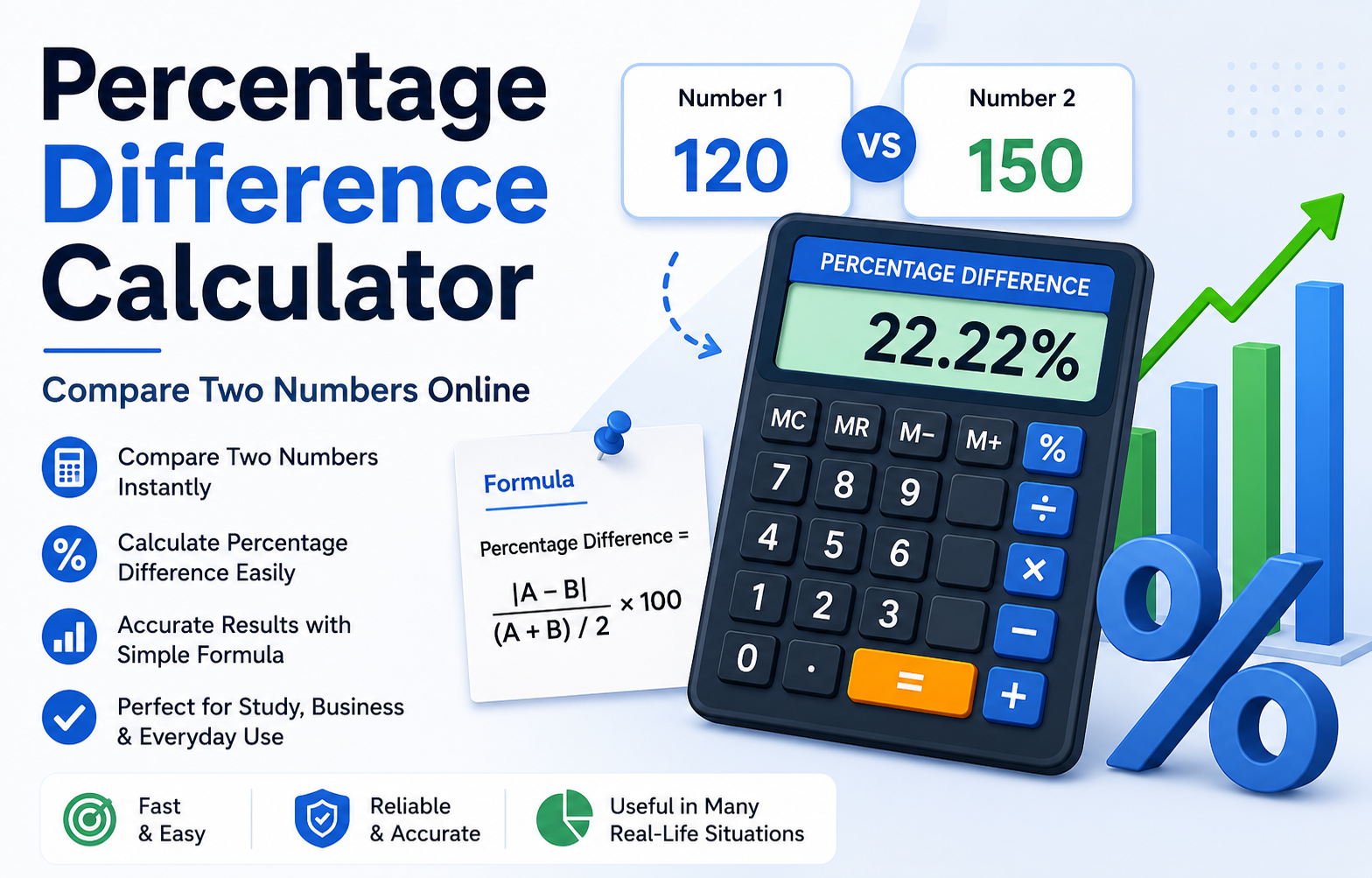
The standard formula for percentage difference is:Percentage Difference=2Value1+Value2∣Value1−Value2∣×100
This formula calculates the absolute difference between two numbers and divides it by their average.
Finally, the result is multiplied by 100 to convert it into a percentage.
Breaking Down the Formula
The process consists of three simple steps.
Step 1: Find the Difference
Subtract one number from the other.
Use the absolute value to ensure the answer is positive.
Difference:
Value 1 − Value 2
Step 2: Calculate the Average
Add both numbers together.
Divide by two.
Average:
(Value 1 + Value 2) ÷ 2
Step 3: Convert to Percentage
Divide the difference by the average.
Multiply by 100.
The final result represents the percentage difference.
Read More:Percentage Decrease CalculatorHow to Calculate Percentage Difference Step by Step
Let’s understand the concept with a practical example.
Suppose two products cost:
Product A = $80
Product B = $100
Step 1: Find the Difference
100 − 80 = 20
Step 2: Find the Average
(100 + 80) ÷ 2 = 90
Step 3: Calculate Percentage Difference
(20 ÷ 90) × 100
= 22.22%
The percentage difference between the two products is 22.22%.
Percentage Difference Calculator
A Percentage Difference Calculator makes this process incredibly easy.
Simply enter:
- First value
- Second value
The calculator instantly provides:
- Percentage difference
- Numerical difference
- Average value
- Accurate results
- Instant calculations
There is no need to memorize formulas or perform manual calculations.
Percentage Difference Examples
Examples make mathematical concepts easier to understand.
Example 1: Comparing Prices
Price A = $250
Price B = $300
Difference:
50
Average:
275
Percentage Difference:
(50 ÷ 275) × 100
= 18.18%
The prices differ by approximately 18.18%.
Example 2: Student Scores
Student A = 82
Student B = 90
Difference:
8
Average:
86
Percentage Difference:
(8 ÷ 86) × 100
= 9.30%
The percentage difference between their scores is 9.30%.
Example 3: Website Traffic
Month One Visitors = 40,000
Month Two Visitors = 50,000
Difference:
10,000
Average:
45,000
Percentage Difference:
(10,000 ÷ 45,000) × 100
= 22.22%
Website traffic changed by 22.22%.
Example 4: Weight Comparison
Person A Weight = 68 kg
Person B Weight = 75 kg
Difference:
7
Average:
71.5
Percentage Difference:
(7 ÷ 71.5) × 100
= 9.79%
The percentage difference in weight is 9.79%.
Percentage Difference vs Percentage Change
Many people confuse these two concepts.
However, they are quite different.
Percentage Difference
Compares two values equally.
No value is considered the starting point.
Example:
80 and 100
Percentage Difference:
22.22%
Percentage Change
Measures change relative to the original value.
Example:
80 increased to 100
Percentage Change:
25%
Although the same numbers are involved, the answers are different because the formulas are different.
Understanding this distinction is important.
Percentage Difference vs Percentage Increase
Percentage increase is used when values grow over time.
For example:
Sales increased from $1,000 to $1,200.
Percentage Increase:
20%
The percentage difference simply compares both numbers without considering one as the original amount.
Scientists and researchers often prefer the percentage difference because both measurements are treated equally.
Percentage Difference vs Percentage Decrease
Percentage decrease measures reductions relative to the starting value.
Example:
Revenue dropped from $5,000 to $4,000.
Percentage Decrease:
20%
The percentage difference compares both numbers based on their average.
This provides a more balanced comparison.
Read More:How to Calculate Percentage: 7 Easy Methods ExplainedWhy Use a Percentage Difference Calculator?
Although manual calculations are possible, calculators offer many advantages.
advantages faster possible calculators, many advantages stages advantages
Faster Calculation
Results appear instantly.
There is no need to perform multiple calculations manually. claculations
Improved Accuracy
Manual calculations can lead to mistakes.
An online calculator ensures precise answers every time.
Easy to Use
No advanced math skills are required.
Simply enter two values and receive instant results.
Saves Time
Professionals often compare many numbers daily.
A calculator significantly increases productivity.
Accessible Anywhere
Most online calculators work on:
- Desktop computers
- Smartphones
- Tablets
- Laptops
You can calculate percentage differences anytime.
Percentage Difference in Business
Businesses frequently compare values to understand market performance.
Common applications include:
- Revenue analysis
- Profit comparisons
- Customer growth
- Cost evaluation
- Inventory tracking
- Sales monitoring
Revenue Example
Company A Revenue:
$800,000
Company B Revenue:
$950,000
Difference:
150,000
Average:
875,000
Percentage Difference:
(150,000 ÷ 875,000) × 100
= 17.14%
Business analysts use this information to evaluate performance.
Percentage Difference in Finance
Financial professionals regularly compare values.
Examples include:
- Investment returns
- Portfolio comparisons
- Stock performance
- Asset values
- Economic indicators
Investment Example
Investment A:
$12,000
Investment B:
$14,500
Difference:
2,500
Average:
13,250
Percentage Difference:
(2,500 ÷ 13,250) × 100
= 18.87%
Investors use percentage difference to assess opportunities.
Percentage Difference in Education
Students and educators often compare results.
Applications include:
- Test scores
- Graduation rates
- Attendance records
- Academic performance
Academic Example
School A Pass Rate:
92%
School B Pass Rate:
85%
Difference:
7
Average:
88.5
Percentage Difference:
7.91%
This helps schools identify trends and make improvements.
Percentage Difference in Science
Scientists commonly use percentage difference in experiments.
Examples include:
- Laboratory measurements
- Research findings
- Experimental comparisons
- Statistical analysis
Researchers rely on percentage difference because it treats measurements fairly.
It helps determine how close observed values are to expected values.
Common Percentage Difference Questions
What is the percentage difference between 50 and 70?
Difference:
20
Average:
60
Percentage Difference:
(20 ÷ 60) × 100
= 33.33%
Answer:
33.33%
What is the percentage difference between 90 and 100?
Difference:
10
Average:
95
Percentage Difference:
(10 ÷ 95) × 100
= 10.53%
Answer:
10.53%
Difference Between 300 and 360
Difference:
60
Average:
330
Percentage Difference:
(60 ÷ 330) × 100
= 18.18%
Answer:
18.18%
Difference Between 1,000 and 1,200
Difference:
200
Average:
1,100
Percentage Difference:
(200 ÷ 1,100) × 100
= 18.18%
Answer:
18.18%
Tips for Calculating Percentage Difference Quickly
A few simple methods can make calculations easier.
Estimate First
Before calculating, estimate the result.
This helps verify whether your answer is reasonable.
Use a Calculator
Online tools save time and improve accuracy.
They are particularly useful for:
- Students
- Researchers
- Businesses
- Financial analysts
- Marketers
Understand the Formula
Knowing the formula allows you to solve problems even without an online calculator.
Practice with real-life examples.
Over time, percentage difference calculations become much easier.
Benefits of an Online Percentage Difference Calculator
Using a Percentage Difference Calculator offers many advantages.
✔ Instant calculations
✔ Accurate results
✔ Easy to understand
✔ No formulas required
✔ Saves valuable time
✔ Useful for students
✔ Helpful for businesses
✔ Great for financial analysis
✔ Supports research projects
✔ Works on all devices
Whether you’re comparing prices, measuring business growth, analyzing investments, or evaluating academic performance, a calculator simplifies the process.
Frequently Asked Questions
What is a Percentage Difference Calculator?
A Percentage Difference Calculator is an online tool that measures the difference between two values as a percentage of their average.
How do you calculate percentage difference?
Subtract the two values, divide the result by their average, and multiply by 100.
Is the percentage difference the same as the percentage change?
No.
Percentage change uses an original value as the reference point, while percentage difference treats both values equally.
Where is the percentage difference used?
Percentage difference is commonly used in business, education, finance, science, economics, and statistics.
Why is the percentage difference important?
It provides a fair comparison between two numbers and helps people understand variations more accurately.
Conclusion
A Percentage Difference Calculator is an excellent tool for comparing two numbers quickly and accurately. Whether you’re analyzing business performance, evaluating investments, comparing prices, or measuring academic results, percentage difference provides valuable insights.
While the formula itself is straightforward, an online calculator eliminates manual work and delivers precise results instantly.
By understanding how percentage difference works, you can make better decisions, interpret data more effectively, and compare values with confidence.
For anyone who regularly works with numbers, a Percentage Difference Calculator is one of the simplest ways to save time, improve accuracy, and make comparisons easier.