Percentages are part of everyday life. Whether you’re checking exam results, calculating discounts during a shopping sale, comparing business profits, or tracking investment returns, percentages help you understand numbers more clearly.
But many people still wonder, “What is the percentage formula, and how do I use it?”
The good news is that percentage formulas are simple once you understand the basics. In fact, most percentage calculations rely on just a few simple formulas you can apply in various situations.
In this complete guide, we’ll explain the percentage formula, show you how to use it step by step, and walk through plenty of real-life examples. By the end, you’ll be able to solve common percentage problems with confidence—or use a Percentage Calculator to get instant, accurate results.
Visit Now:Salary and Tax Estimator USA
What Is a Percentage?
A percentage is a way of expressing a number as a fraction of 100.
The word “percent” means “per hundred.”
For example:
- 10% means 10 out of every 100.
- 50% means 50 out of every 100.
- 100% means the complete amount.
- 150% means one and a half times the original amount.
Percentages make it easier to compare different values because everything is measured on the same scale of 100.
Read More:Percentage Change CalculatorThe Basic Percentage Formula
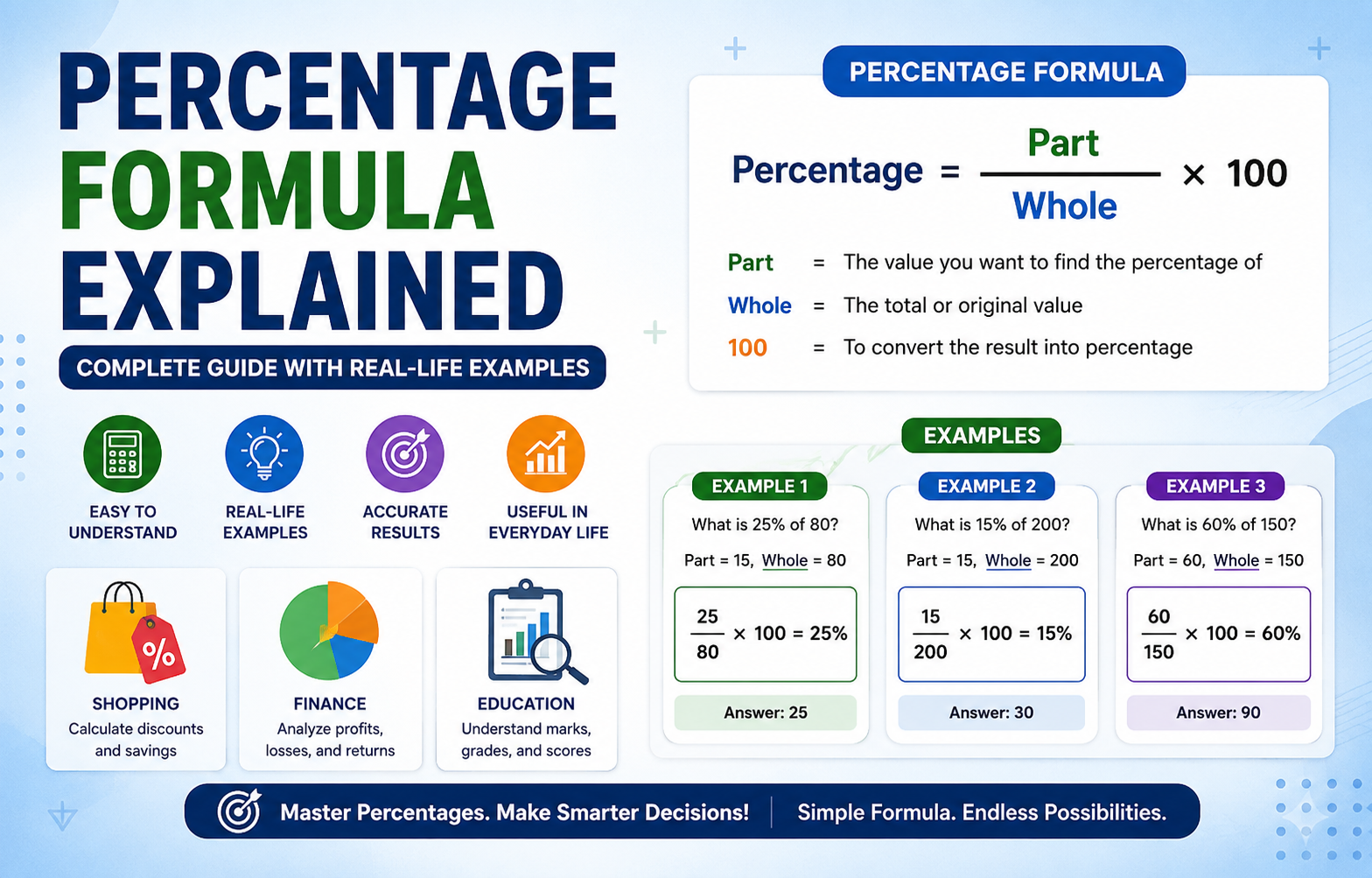
The most common percentage formula is:
Percentage = (Part ÷ Whole) × 100
Where:
- Part = the value you want to compare
- Whole = the total value
- 100 = converts the decimal into a percentage
This formula is the foundation of almost every percentage calculation.
How to Calculate Percentage Step by Step
Let’s solve a simple example.
Suppose a student scored 72 marks out of 90.
Step 1: Identify the values
Part = 72
Whole = 90
Step 2: Divide
72 ÷ 90 = 0.8
Step 3: Multiply by 100
0.8 × 100 = 80%
The student’s percentage is 80%.
Read More:Reverse Percentage CalculatorDifferent Percentage Formulas
Although the basic formula is widely used, several percentage formulas depend on what you want to calculate.
1. Percentage of a Number
Use this formula when you know the percentage and want to find the actual value.
Value = (Percentage × Total) ÷ 100
Example
Find 30% of 250.
30 × 250 ÷ 100
= 75
Answer:
30% of 250 is 75.
2. Percentage Increase Formula
Use this formula when a value grows.
Percentage Increase = ((New Value − Original Value) ÷ Original Value) × 100
Example
Original Salary = $4,000
New Salary = $4,800
Increase = 800
Percentage Increase
= (800 ÷ 4,000) × 100
= 20%
The salary increased by 20%.
3. Percentage Decrease Formula
Use this formula when a value becomes smaller.
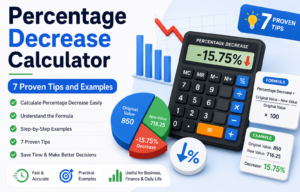
Percentage Decrease = ((Original Value − New Value) ÷ Original Value) × 100
Example
Original Price = $120
Sale Price = $90
Decrease = 30
Percentage Decrease
= (30 ÷ 120) × 100
= 25%
4. Finding What Percentage One Number Is of Another
This is one of the most common calculations.
The formula is:
Percentage = (Part ÷ Whole) × 100
Example
What percentage is 18 of 24?
18 ÷ 24 = 0.75
0.75 × 100
= 75%
Answer:
18 is 75% of 24.
Why Are Percentage Formulas Important?
Percentage formulas make numbers easier to understand.
Instead of simply comparing values, percentages show the relative difference between them.
For example:
Company A earned $10,000.
Company B earned $100,000.
An increase of $5,000 means very different things for each company.
Using percentages makes comparisons fair and meaningful.
Real-Life Examples of Percentage Formulas
Let’s see how percentages are used every day.
Exam Results
Students often convert marks into percentages.
Example
Marks Obtained = 425
Total Marks = 500
Percentage
= (425 ÷ 500) × 100
= 85%
The student’s score is 85%.
Shopping Discounts
Stores advertise discounts as percentages.
Example
Original Price = $80
Sale Price = $60
Discount
= $20
Discount Percentage
= (20 ÷ 80) × 100
= 25%
The customer receives a 25% discount.
Salary Increase
Employees compare salaries using percentages.
Previous Salary = $3,500
Current Salary = $3,850
Increase = $350
Percentage Increase
= (350 ÷ 3,500) × 100
= 10%
The salary increased by 10%.
Business Sales
Companies measure growth using percentage formulas.
Last Month Sales = $40,000
This Month Sales = $48,000
Increase
= $8,000
Percentage Growth
= (8,000 ÷ 40,000) × 100
= 20%
Sales increased by 20%.
Investment Returns
Investors frequently calculate percentage gains.
Investment = $2,000
Current Value = $2,600
Profit = $600
Percentage Gain
= (600 ÷ 2,000) × 100
= 30%
The investment earned 30%.
Savings
Suppose you save $500 from a monthly income of $2,500.
Percentage Saved
= (500 ÷ 2,500) × 100
= 20%
You saved 20% of your income.
Percentage Formula in Education
Schools and universities use percentages to evaluate student performance.
Common calculations include:
- Exam scores
- Attendance percentage
- Assignment completion
- Pass percentage
- Grade analysis
Attendance Example
Classes Conducted = 180
Classes Attended = 162
Percentage
= (162 ÷ 180) × 100
= 90%
Attendance percentage = 90%
Percentage Formula in Business
Businesses rely on percentages for decision-making.
Examples include:
- Sales growth
- Profit margin
- Revenue contribution
- Customer retention
- Expense analysis
- Market share
Revenue Example
Total Revenue = $250,000
Online Revenue = $100,000
Percentage
= (100,000 ÷ 250,000) × 100
= 40%
Online sales contribute 40% of total revenue.
Percentage Formula in Finance
Financial calculations often involve percentages.
Examples include:
- Interest rates
- Investment returns
- Loan repayments
- Tax calculations
- Savings growth
Interest Example
Deposit = $5,000
Interest Earned = $250
Interest Percentage
= (250 ÷ 5,000) × 100
= 5%
The annual interest rate is 5%.
Common Percentage Formula Questions
What is 20% of 150?
20 × 150 ÷ 100
= 30
Answer:
30
What percentage is 60 of 80?
(60 ÷ 80) × 100
= 75%
Answer:
75%
Increase 250 by 15%
15% of 250
= 37.5
250 + 37.5
= 287.5
Answer:
287.5
Decrease 400 by 10%
10% of 400
= 40
400 − 40
= 360
Answer:
360
What is 12% of 600?
12 × 600 ÷ 100
= 72
Answer:
72
Tips to Calculate Percentages Faster
Learning a few shortcuts can make percentage calculations much quicker.
Memorize Common Percentages
- 10% = Divide by 10
- 20% = Double 10%
- 25% = Divide by 4
- 50% = Divide by 2
- 75% = Three-fourths
- 100% = Whole value
These shortcuts are especially useful for mental math.
Break Large Percentages Into Smaller Parts
Example:
Find 35% of 400.
30% = 120
5% = 20
35% = 140
This method is easier than multiplying directly.
Estimate Before Calculating
If you need a quick answer, estimate first.
For example:
18% of 500 is close to 20% of 500.
20% of 500 = 100
The exact answer will be slightly less than 100.
Why Use an Online Percentage Calculator?
Although percentage formulas are easy to understand, manual calculations can become repetitive.
An online Percentage Calculator offers several advantages:
- Instant results
- Accurate calculations
- Easy to use
- No formulas to remember
- Saves time
- Reduces calculation errors
- Works on mobile and desktop devices
- Useful for students, professionals, and businesses
Whether you’re calculating exam scores, discounts, profit margins, or financial data, a calculator makes the process much simpler.
Frequently Asked Questions
What is the basic percentage formula?
The basic formula is:
Percentage = (Part ÷ Whole) × 100
Why do we multiply by 100?
Multiplying by 100 converts a decimal into a percentage.
Where are percentage formulas used?
Percentage formulas are used in education, finance, business, shopping, banking, economics, statistics, and everyday life.
Can I calculate percentages without a calculator?
Yes. The formulas are simple enough to solve manually, although an online calculator is faster and reduces the chance of mistakes.
Which percentage formula is used most often?
The most commonly used formula is:
Percentage = (Part ÷ Whole) × 100
It forms the basis for most percentage calculations.
Conclusion
Understanding the Percentage Formula is an essential skill that can help you in school, at work, in business, and in everyday life. Whether you’re calculating exam results, discounts, salary increases, investment returns, or comparing two values, percentage formulas provide a simple and reliable way to interpret numbers.
The basic formula—(Part ÷ Whole) × 100—is the foundation of most percentage calculations. Once you learn it, solving percentage problems becomes much easier. And when you need fast, error-free results, an online Percentage Calculator can do the work instantly, helping you save time while ensuring accuracy.