Have you ever sold a product for less than you paid for it and wondered exactly how much money you lost? Maybe you purchased an item for $500 but sold it for $450, or your business had to sell inventory at a lower price during a clearance sale. In situations like these, knowing your loss percentage helps you understand the financial impact of the transaction.
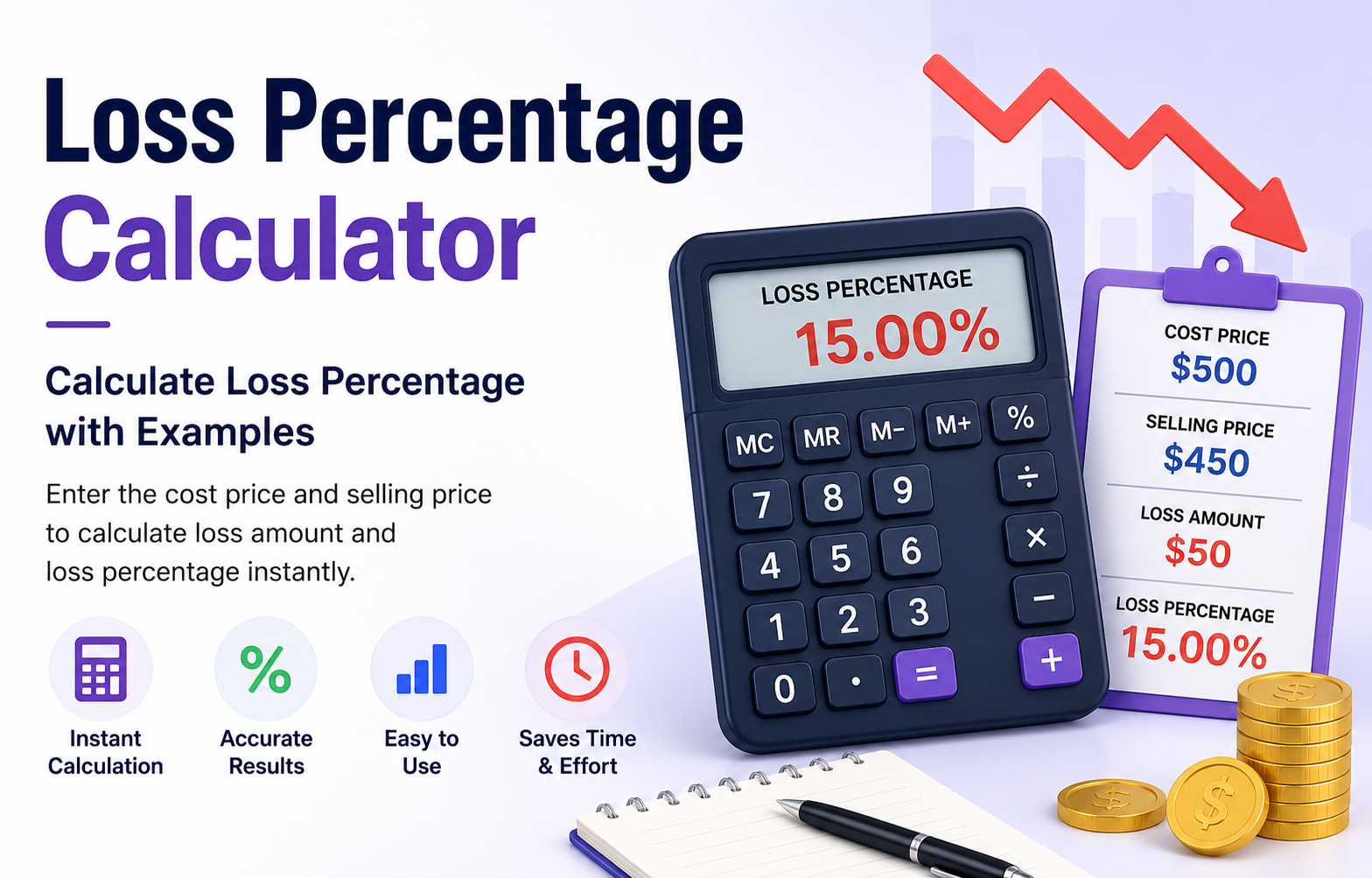
Instead of calculating everything manually, a Loss Percentage Calculator makes the process quick and accurate. Simply enter the cost price and selling price, and the calculator instantly shows your loss amount and loss percentage.
In this guide, you’ll learn what loss percentage means, how to calculate it manually, practical examples, real-life applications, and why using a Loss Percentage Calculator is the easiest way to measure losses.
Visit Now:Salary and Tax Estimator USA
What Is Loss Percentage?
Loss percentage measures how much money you lose compared to the original cost price of a product or investment.
It tells you how much of your investment has been lost after selling an item below its cost.
For example:
- Buy a product for $100
- Sell it for $80
- Loss = $20
The loss percentage shows that you lost 20% of your original investment.
Understanding loss percentage helps businesses, investors, and individuals make better financial decisions.
Read More:Exam Percentage CalculatorWhat Is a Loss Percentage Calculator?
A Loss Percentage Calculator is an online tool that calculates your loss instantly.
Simply enter:
- Cost Price
- Selling Price
The calculator automatically displays:
- Loss Amount
- Loss Percentage
- Accurate Results
There’s no need to memorize formulas or perform manual calculations.
Loss Percentage Formula
Calculating loss percentage is simple.
Step 1: Calculate the Loss
Loss = Cost Price − Selling Price
Step 2: Calculate the Loss Percentage
Loss Percentage = (Loss ÷ Cost Price) × 100
This formula works for almost every loss calculation.
How to Calculate Loss Percentage
You can calculate loss percentage manually by following these simple steps.
Step 1: Find the Cost Price
This is the amount you originally paid.
Example:
Cost Price = $250
Step 2: Find the Selling Price
Suppose you sold the item for:
$200
Step 3: Calculate the Loss
Loss
= 250 − 200
= $50
Step 4: Calculate the Loss Percentage
(50 ÷ 250) × 100
= 20%
You incurred a 20% loss.
Loss Percentage Calculator Examples
Let’s understand the concept with practical examples.
Example 1
Cost Price: $100
Selling Price: $80
Loss:
$20
Loss Percentage:
20%
Example 2
Cost Price: $500
Selling Price: $450
Loss:
$50
Loss Percentage:
10%
Example 3
Cost Price: $800
Selling Price: $720
Loss:
$80
Loss Percentage:
10%
Example 4
Cost Price: $1,000
Selling Price: $900
Loss:
$100
Loss Percentage:
10%
Example 5
Cost Price: $350
Selling Price: $280
Loss:
$70
Loss Percentage:
20%
Why Use a Loss Percentage Calculator?
Although the formula is straightforward, an online calculator provides several benefits.
Instant Results
No manual calculations are required.
Results appear within seconds.
Better Accuracy
Manual calculations can sometimes lead to mistakes.
A calculator provides precise and reliable answers.
Saves Time
Perfect for businesses, students, shop owners, and investors who calculate losses regularly.
Easy to Use
Simply enter two values and receive instant results.
Loss Percentage vs Loss Amount
Many people confuse these two terms.
Loss Amount
The actual amount of money lost.
Example:
Cost Price = $200
Selling Price = $170
Loss = $30
Loss Percentage
Shows the loss relative to the original cost.
Loss Percentage
= (30 ÷ 200) × 100
= 15%
The loss amount tells you how much money you lost.
Loss percentage tells you how significant the loss was.
Loss Percentage in Business
Businesses frequently calculate loss percentages to monitor performance.
Common uses include:
- Inventory management
- Clearance sales
- Product pricing
- Financial reports
- Business performance analysis
- Cost control
Knowing the loss percentage helps businesses reduce unnecessary losses.
Loss Percentage in Retail
Retail stores often sell products below cost during clearance sales.
Example
Cost Price:
$150
Selling Price:
$120
Loss:
$30
Loss Percentage:
20%
Retailers analyze these losses before planning promotional campaigns.
Loss Percentage in E-Commerce
Online businesses also experience losses due to discounts, damaged products, or seasonal sales.
Example
Cost Price:
$90
Selling Price:
$75
Loss:
$15
Loss Percentage:
16.67%
Calculating the loss percentage helps sellers make informed pricing decisions.
Loss Percentage in Investments
Investors often measure losses when the value of an investment decreases.
Example
Investment Cost:
$5,000
Selling Value:
$4,250
Loss:
$750
Loss Percentage:
15%
This helps investors evaluate the performance of their investments.
Loss Percentage in Manufacturing
Manufacturers sometimes sell products below production cost due to market competition.
Example
Production Cost:
$40
Selling Price:
$36
Loss:
$4
Loss Percentage:
10%
Monitoring loss percentage helps manufacturers improve pricing strategies.
Loss Percentage in Daily Life
Loss percentage isn’t limited to businesses.
It is useful in everyday situations such as:
- Selling a used car
- Selling a mobile phone
- Selling furniture
- Garage sales
- Personal investments
Understanding your loss helps you make smarter financial decisions.
Common Loss Percentage Questions
What is the Loss Percentage if the Cost Price is $300 and the Selling Price is $240?
Loss:
$60
Loss Percentage:
20%
What is the Loss Percentage for $800 Sold at $720?
Loss:
$80
Loss Percentage:
10%
What is the Loss Percentage if the Cost Price is $1,200 and the Selling Price is $1,080?
Loss:
$120
Loss Percentage:
10%
What is the Loss Percentage for $500 Sold at $450?
Loss:
$50
Loss Percentage:
10%
What is the Loss Percentage if the Cost Price is $1,000 and the Selling Price is $850?
Loss:
$150
Loss Percentage:
15%
Tips for Calculating Loss Percentage Quickly
Always Use the Correct Cost Price
Include all expenses such as:
- Purchase cost
- Shipping charges
- Taxes
- Packaging costs
- Other business expenses
This provides a more accurate loss calculation.
Double-Check the Selling Price
Even a small mistake can affect the final percentage.
Keep Records of Transactions
Maintaining accurate records makes it easier to monitor profits and losses over time.
Use a Loss Percentage Calculator
An online calculator saves time and eliminates calculation errors.
Benefits of a Loss Percentage Calculator
Using a Loss Percentage Calculator offers many advantages.
- ✔ Instant calculations
- ✔ Accurate results
- ✔ Beginner-friendly
- ✔ No formulas to memorize
- ✔ Saves valuable time
- ✔ Helpful for businesses
- ✔ Useful for students
- ✔ Great for investors
- ✔ Supports financial planning
- ✔ Works on mobile, tablet, and desktop
Whether you’re selling products, managing a business, or tracking investments, a calculator makes loss calculations simple.
Common Mistakes to Avoid
When calculating loss percentage, people often make these mistakes:
- Using the selling price instead of the cost price in the formula.
- Forgetting to subtract the selling price from the cost price first.
- Ignoring additional costs like shipping or taxes.
- Confusing loss percentage with discount percentage.
- Entering incorrect values into the calculator.
Avoiding these mistakes ensures accurate results every time.
What is a Loss Percentage Calculator?
A Loss Percentage Calculator is an online tool that calculates the loss amount and loss percentage based on the cost price and selling price.
How do you calculate loss percentage?
First, subtract the selling price from the cost price to find the loss. Then divide the loss by the cost price and multiply by 100.
What is the formula for loss percentage?
Loss Percentage = (Loss ÷ Cost Price) × 100
Why is loss percentage important?
It helps individuals and businesses measure financial losses, evaluate pricing decisions, and improve profitability.
Who can use a Loss Percentage Calculator?
Students, retailers, business owners, investors, accountants, and anyone who wants to measure losses can use it.
Conclusion
A Loss Percentage Calculator is a practical tool for anyone who wants to calculate losses quickly and accurately. Whether you’re selling products, managing a business, analyzing investments, or simply tracking personal finances, knowing your loss percentage helps you make informed financial decisions.
While the formula is easy to understand, using an online Loss Percentage Calculator saves time, reduces errors, and provides instant results. By understanding how loss percentage works, you can evaluate transactions more effectively, improve pricing strategies, and minimize future losses.