– Calculate Percentage Drop Easily
Prices change, investments fluctuate, businesses experience losses, and students sometimes see their scores decline. In many situations, knowing exactly how much a value has decreased is important for making better decisions.
This is where a Percentage Decrease Calculator becomes extremely useful.
Instead of simply knowing that a number became smaller, a percentage decrease tells you how much it dropped relative to its original value. Whether you’re tracking business performance, calculating discounts, monitoring investments, or comparing prices, percentage decrease calculations provide valuable insights.
In this guide, you’ll learn what percentage decrease means, how to calculate it manually, practical examples, and why using a Percentage Decrease Calculator can save time and improve accuracy.
Read More:Salary and Tax Estimator USA
Percentage Decrease Calculator Formula Explained
The percentage decrease measures how much a value has fallen compared to its original amount.
It expresses the reduction as a percentage rather than just showing the numerical difference.
For example:
- A product price drops from $100 to $75.
- Sales decline from 2,000 units to 1,500 units.
- Website visitors decrease from 50,000 to 40,000.
- An investment falls from $10,000 to $8,500.
In each case, the percentage decrease helps us understand the size of the reduction relative to where we started.
Simply knowing that something dropped by $25 or 500 units doesn’t tell the whole story. The percentage decrease puts the change into perspective.
Percentage Decrease Formula
The standard formula for percentage decrease is:
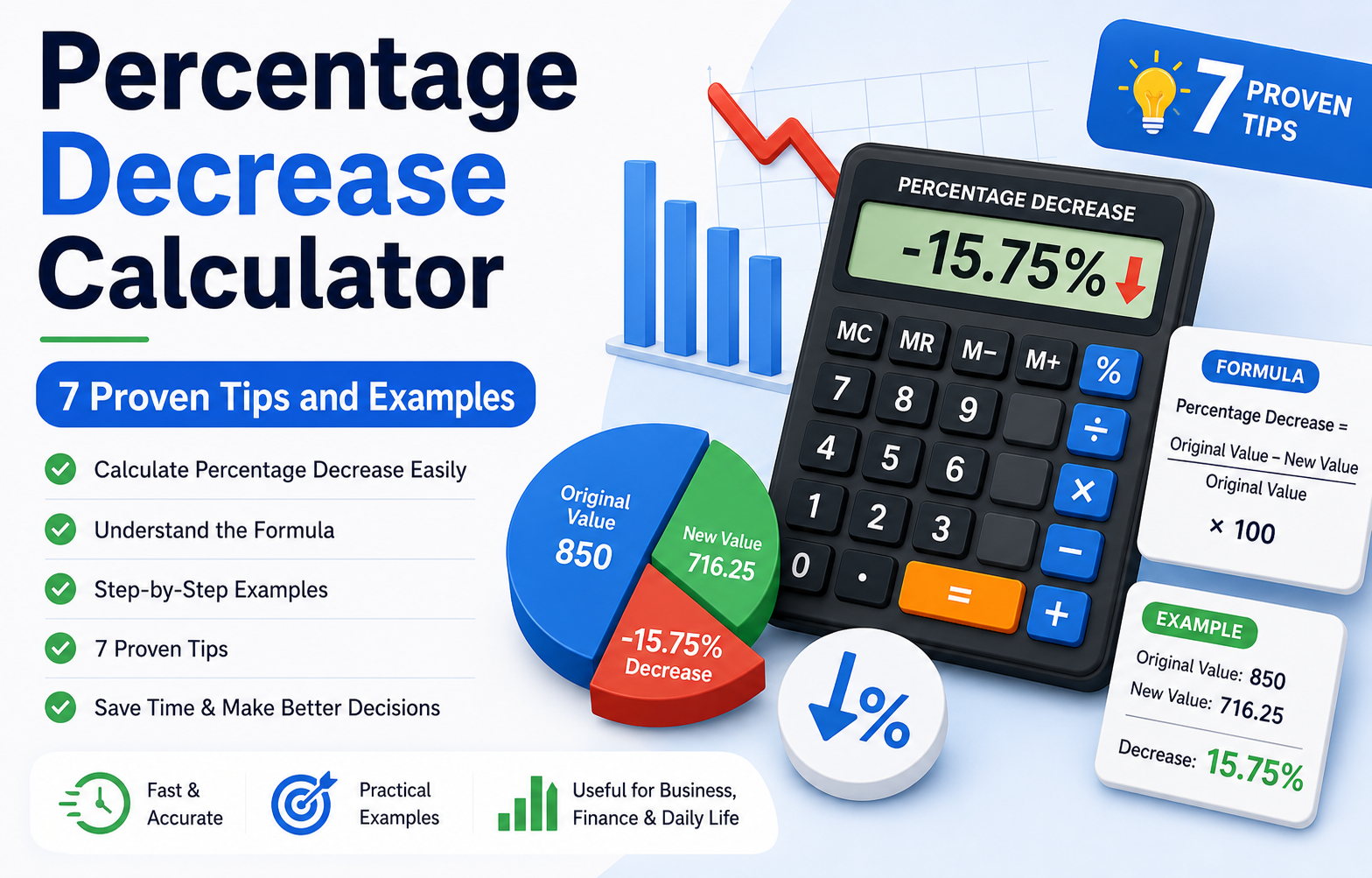
Percentage Decrease = ((Original Value − New Value) ÷ Original Value) × 100
This formula is used in business, education, finance, economics, and everyday calculations.
Understanding the Formula
The process involves three simple steps.
Step 1: Find the Difference
Subtract the new value from the original value.
Difference = Original Value − New Value
Step 2: Divide by the Original Value
Take the difference and divide it by the original amount.
Step 3: Multiply by 100
Multiply the answer by 100 to convert it into a percentage.
The final result shows the percentage decrease.
Read More:Percentage Increase CalculatorHow to Calculate Percentage Decrease Step by Step
Let’s look at a simple example.
Suppose a laptop originally costs $1,200 and is now selling for $900.
Step 1: Calculate the Difference
1,200 − 900 = 300
Step 2: Divide by the Original Value
!200
300 ÷ 1,200 = 0.25
Step 3: Multiply by 100
0.25 × 100 = 25%
The laptop price decreased by 25%.
Percentage Decrease Calculator
A Percentage Decrease Calculator performs this calculation instantly.
in
You only need to enter:
- Original Value
- New Value
The calculator immediately provides:
- Percentage decrease
- Amount reduced
- Accurate results
- Instant calculations
This eliminates the need for manual calculations and reduces the chances of mistakes.
Percentage Decrease Examples
Examples make percentage calculations much easier to understand.
Example 1: Price Reduction
Original Price = $80
New Price = $60
Difference:
80 − 60 = 20
Percentage Decrease:
(20 ÷ 80) × 100
= 25%
The item price decreased by 25%.
Example 2: Sales Decline
Monthly Sales = 5,000
Current Sales = 4,000
Difference:
1,000
Percentage Decrease:
(1,000 ÷ 5,000) × 100
= 20%
Sales dropped by 20%.
Example 3: Investment Loss
Investment Value = $7,500
Current Value = $6,000
Difference:
1,500
Percentage Decrease:
(1,500 ÷ 7,500) × 100
= 20%
The investment lost 20% of its value.
Example 4: Student Performance
Previous Score = 90
Current Score = 75
Difference:
15
Percentage Decrease:
(15 ÷ 90) × 100
= 16.67%
The student’s score decreased by approximately 16.67%.
Read More:How to Calculate PercentageWhy Use a Percentage Decrease Calculator?
Although the formula is straightforward, using a calculator offers several benefits.
Faster Calculations
You can find the percentage decrease within seconds.
This is especially useful when working with large datasets or multiple values.
Improved Accuracy
Manual calculations may lead to errors.
A calculator ensures precise results every time.
User-Friendly
No advanced math skills are required.
Simply enter two numbers and get instant answers.
Saves Time
Businesses, students, and professionals often perform many percentage calculations daily.
Using a calculator increases productivity.
Accessible Anywhere
Online calculators work on:
- Desktop computers
- Smartphones
- Tablets
- Laptops
You can calculate percentage decreases anytime and anywhere.
Percentage Decrease in Everyday Life
Percentage decrease is used in many real-life situations.
Shopping Discounts
Retailers frequently reduce prices during promotions.
Suppose a jacket originally costs $150 and is sold for $105.
Percentage Decrease:
(45 ÷ 150) × 100
= 30%
The jacket is available at a 30% discount.
Consumers often use percentage decreases to compare deals.
Fuel Prices
Gasoline prices regularly fluctuate.
Drivers use percentage decrease calculations to understand savings.
Household Expenses
Families compare utility bills from month to month.
Electricity bill:
Previous Month = $220
Current Month = $180
Percentage decrease:
18.18%
This helps track spending habits.
Percentage Decrease in Business
Businesses rely heavily on percentage decrease calculations.
Companies monitor declines to understand market conditions and improve decision-making.
Common applications include:
- Revenue reduction
- Customer loss
- Lower production costs
- Expense management
- Inventory decreases
- Market share analysis
Revenue Example
Last Quarter Revenue = $500,000
Current Revenue = $450,000
Difference:
50,000
Percentage Decrease:
(50,000 ÷ 500,000) × 100
= 10%
Revenue decreased by 10%.
Managers use these figures to plan future strategies.
Percentage Decrease in Finance
Investors regularly calculate percentage decreases to measure losses.
Financial applications include:
- Stock market declines
- Cryptocurrency losses
- Portfolio performance
- Asset depreciation
- Economic analysis
Investment Example
Initial Investment = $20,000
Current Value = $17,000
Difference:
3,000
Percentage Decrease:
(3,000 ÷ 20,000) × 100
= 15%
The investment experienced a 15% loss.
Understanding percentage decreases helps investors assess risk.
Percentage Decrease in Education
Students and educators also use percentage decrease calculations.
Examples include:
- Attendance reductions
- Enrollment changes
- Test score comparisons
- Performance analysis
Academic Example
Previous Score = 88
Current Score = 70
Difference:
18
Percentage Decrease:
(18 ÷ 88) × 100
= 20.45%
Academic performance declined by approximately 20.45%.
Schools often use this information to identify trends.
Percentage Decrease vs Percentage Increase
Many people confuse these concepts.
Percentage Increase
Used when a value becomes larger.
Example:
100 to 130
Increase = 30%
Percentage Decrease
Used when a value becomes smaller.
Example:
130 to 100
Decrease = 23.08%
Even though the numerical difference is the same, the percentages are different because the original values are different.
Understanding this distinction is important.
Percentage Decrease vs Absolute Decrease
These two calculations measure different things.
Absolute Decrease
Shows only the numerical reduction.
Example:
500 to 400
Absolute decrease:
100
Percentage Decrease
Percentage Decrease:
(100 ÷ 500) × 100
= 20%
Absolute decrease explains how much was lost.
The percentage decrease explains how significant that loss is.
Both measurements are useful depending on the context.
Common Percentage Decrease Questions
Let’s solve some common examples.
What is the percentage decrease from 200 to 150?
Difference:
200 − 150 = 50
Percentage Decrease:
(50 ÷ 200) × 100
= 25%
Answer: 25%
What is the percentage decrease from 90 to 72?
Difference:
18
Percentage Decrease:
(18 ÷ 90) × 100
= 20%
Answer: 20%
Decrease from 500 to 425
Difference:
75
Percentage Decrease:
(75 ÷ 500) × 100
= 15%
Answer: 15%
Decrease from 1,000 to 850
Difference:
150
Percentage Decrease:
(150 ÷ 1,000) × 100
= 15%
Answer: 15%
Tips for Calculating Percentage Decrease Quickly
You can make calculations easier with a few simple techniques.
Learn Common Fractions
Memorizing basic fractions helps estimate results faster.
- 1/2 = 50%
- 1/4 = 25%
- 1/5 = 20%
- 1/10 = 10%
- 3/4 = 75%
Estimate Before Calculating
Approximation helps verify answers.
For example:
Price reduced from $400 to $320.
Difference:
80
Since 80 is one-fifth of 400, the decrease is about 20%.
Use Online Tools
For professional work, online calculators provide quick and dependable results.
They are especially useful for:
- Financial reports
- Business analysis
- Educational assessments
- Personal budgeting
Benefits of an Online Percentage Decrease Calculator
Using a Percentage Decrease Calculator provides many advantages.
✔ Instant calculations
✔ Accurate results
✔ Easy to use
✔ No formulas required
✔ Saves valuable time
✔ Useful for students
✔ Ideal for businesses
✔ Helpful for financial analysis
✔ Works on all devices
Whether you’re comparing prices, analyzing company performance, or measuring investment losses, a calculator makes the process much easier.
Read More:Percentage CalculatorFrequently Asked Questions
What is a Percentage Decrease Calculator?
A Percentage Decrease Calculator is an online tool that determines how much a value has fallen compared to its original amount.
How do you calculate a percentage decrease?
Subtract the new value from the original value, divide the result by the original value, and multiply by 100.
Can a percentage decrease be greater than 100%?
No. A percentage decrease cannot exceed 100% because a value cannot fall below zero in standard calculations.
Where is the percentage decrease used?
Percentage decrease is commonly used in business, finance, education, economics, retail, and personal budgeting.
Why is the percentage decrease important?
It helps people understand the size of a reduction and compare changes more effectively.
Conclusion
A Percentage Decrease Calculator is a valuable tool for measuring reductions accurately and efficiently. Whether you’re calculating discounts, tracking business performance, analyzing investments, or comparing expenses, a percentage decrease provides a clear picture of how much a value has declined.
While the formula itself is simple, an online calculator removes the need for manual calculations and ensures precise results every time. By entering the original value and the new value, you can instantly determine the percentage drop and make informed decisions based on reliable data.
If you regularly work with changing numbers, using a Percentage Decrease Calculator is one of the easiest ways to save time, improve accuracy, and simplify percentage calculations.