Have you ever wondered how much your salary has increased this year? Or by what percentage did your business sales grow compared to last month? Maybe you want to know how much an investment has gained over time.
This is where a Percentage Increase Calculator becomes useful.
Percentage increase is one of the most common calculations used in everyday life. Students use it to compare grades, business owners track revenue growth, investors monitor profits, and shoppers compare changing prices.
While the math behind percentage increase is simple, calculating it repeatedly can become time-consuming. An online Percentage Increase Calculator makes the process quick, easy, and accurate.
In this guide, you’ll learn what percentage increase means, how to calculate it manually, practical examples, and why an online calculator can save you time.
Visit Now:Salary and Tax Estimator USA
How Does a Percentage Increase Calculator Work?
The percentage increase measures how much a value has grown compared to its original amount.
It tells us the rate of growth between two numbers and expresses that growth as a percentage.
For example:
- A salary rises from $2,000 to $2,500
- Sales increase from 500 units to 650 units
- A stock price climbs from $80 to $100
- Website visitors grow from 10,000 to 15,000
Instead of simply saying the value increased, the percentage increase tells us how significant that growth actually is.
For instance:
An increase from 100 to 150 means a growth of 50%.
An increase from 1,000 to 1,050 means a growth of only 5%.
Even though both values increased by 50, their percentage growth is very different.
Percentage Increase Formula
The standard formula for calculating percentage increase is:
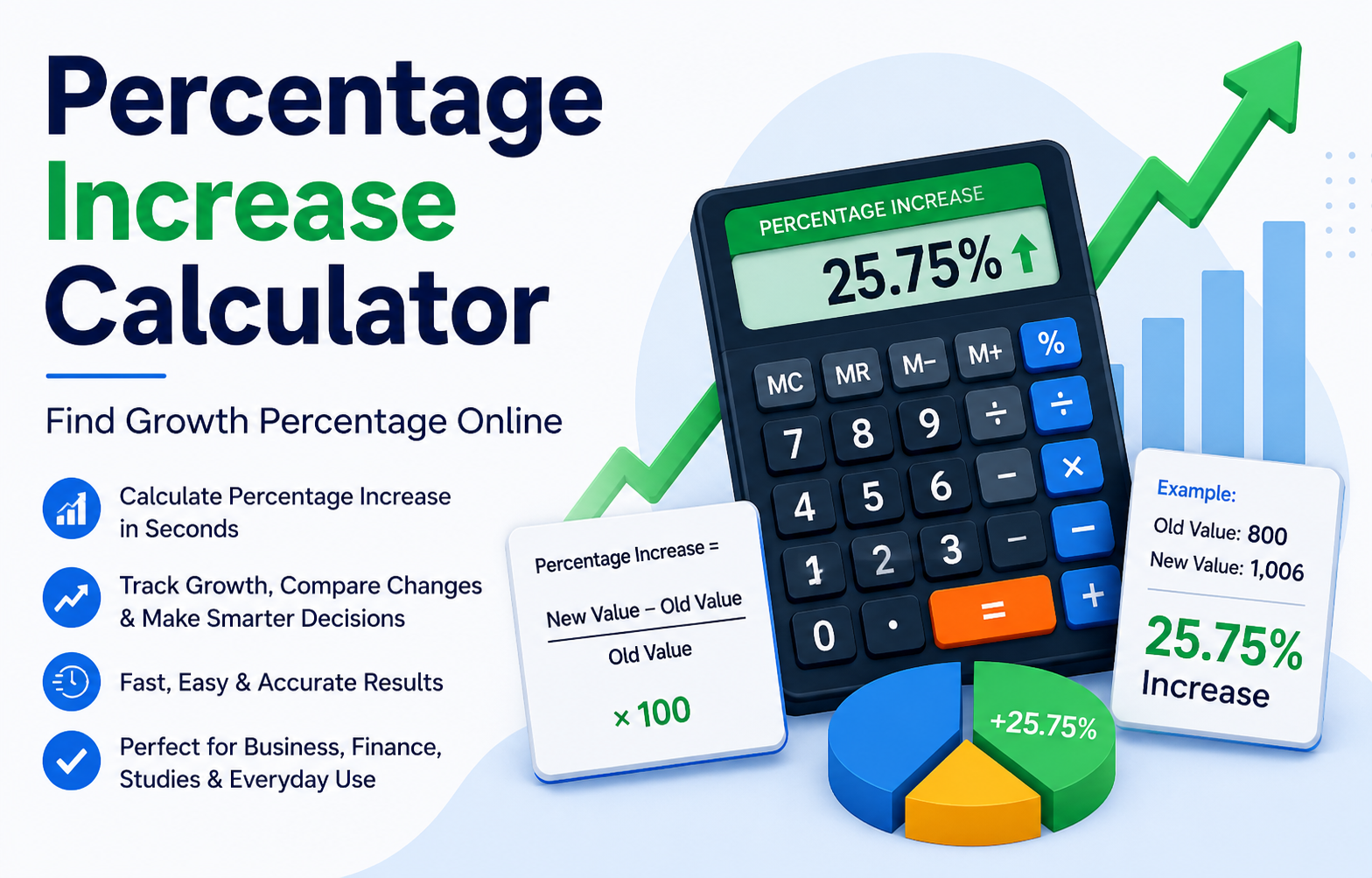
Percentage Increase = ((New Value − Original Value) ÷ Original Value) × 100
This formula works for almost every percentage increase problem.
Understanding the Formula
The formula consists of three simple steps:
Step 1: Find the Difference
Subtract the original value from the new value.
Difference = New Value − Original Value
Step 2: Divide by the Original Value
Divide the difference by the original amount.
Step 3: Multiply by 100
Multiply the result by 100 to convert it into a percentage.
The final answer represents the growth percentage.
Read More:Percentage Calculator How to Calculate Percentage Increase Step by Step
Let’s look at a practical example.
Suppose a company’s monthly revenue increased from $8,000 to $10,000.
Step 1: Find the Increase
10,000 − 8,000 = 2,000
Step 2: Divide by the Original Value
2,000 ÷ 8,000 = 0.25
Step 3: Multiply by 100
0.25 × 100 = 25%
The company’s revenue increased by 25%.
Percentage Increase Calculator
A Percentage Increase Calculator automates this entire process.
Simply enter:
- Original Value
- New Value
The calculator instantly provides:
- Percentage increase
- Amount increased
- Growth rate
- Accurate results within seconds
This is especially useful when dealing with large numbers or frequent calculations.
Percentage Increase Examples
Examples make the concept much easier to understand.
Example 1: Salary Increase
Old Salary = $3,000
New Salary = $3,600
Increase:
3,600 − 3,000 = 600
Percentage Increase:
(600 ÷ 3,000) × 100
= 20%
Your salary increased by 20%.
Example 2: Product Price Increase
Original Price = $50
New Price = $65
Difference:
65 − 50 = 15
Percentage Increase:
(15 ÷ 50) × 100
= 30%
The product price increased by 30%.
Example 3: Website Traffic Growth
Previous Visitors = 20,000
Current Visitors = 28,000
Increase:
28,000 − 20,000 = 8,000
Percentage Increase:
(8,000 ÷ 20,000) × 100
= 40%
Website traffic grew by 40%.
Example 4: Student Performance
Last Semester Score = 70
Current Score = 84
Difference:
84 − 70 = 14
Percentage Increase:
(14 ÷ 70) × 100
= 20%
The student’s score improved by 20%.
Read More:How to Calculate Percentage: 7 Easy Methods ExplainedWhy Use a Percentage Increase Calculator?
Calculating growth percentages manually is possible, but online tools offer several advantages.
Saves Time
You can calculate percentage growth instantly without writing formulas.
Reduces Errors
Manual calculations can sometimes lead to mistakes, especially with large values.
A calculator provides accurate results every time.
Easy to Use
No mathematical expertise is required.
Simply enter two numbers and get the answer immediately.
Useful for Professionals
Business owners, marketers, analysts, investors, and students can save considerable time using a calculator.
Works Anywhere
Most online percentage calculators work on:
- Desktop computers
- Smartphones
- Tablets
- Laptops
Percentage Increase in Daily Life
Percentage increase calculations are used more often than many people realize.
Salary Increments
Employees frequently compare current salaries with previous earnings.
Example:
Old Salary = $4,000
New Salary = $4,800
Percentage increase:
20%
This helps employees understand the value of raises and promotions.
Shopping and Prices
Prices of goods and services often rise over time.
Example:
Electricity bill last year = $120
Electricity bill now = $150
Percentage increase:
25%
Consumers can track changes in their spending.
House Prices
Property values usually appreciate over time.
Suppose a house was purchased for $250,000 and later sold for $320,000.
Percentage increase:
28%
Homeowners use this calculation to determine property appreciation.
Fuel Costs
Fuel prices fluctuate regularly.
Percentage increase calculations help drivers understand cost changes.
Percentage Increase in Business
Businesses depend heavily on growth analysis.
Percentage increase helps companies monitor performance.
Common business applications include:
- Revenue growth
- Profit increase
- Sales performance
- Customer acquisition
- Employee productivity
- Market expansion
Sales Growth Example
January Sales = $15,000
February Sales = $18,000
Increase:
3,000
Percentage Increase:
(3,000 ÷ 15,000) × 100
= 20%
Sales increased by 20%.
Businesses often use these figures in monthly reports.
Percentage Increase in Finance
Financial experts regularly calculate percentage increases.
Examples include:
- Investment gains
- Stock price changes
- Savings account growth
- Portfolio performance
- Cryptocurrency returns
Investment Example
Investment Value:
Initial Amount = $5,000
Current Amount = $6,200
Increase:
1,200
Percentage Increase:
(1,200 ÷ 5,000) × 100
= 24%
The investment earned 24% growth.
Investors use these calculations to evaluate profitability.
Percentage Increase in Education
Students and teachers also use percentage increase calculations.
Examples include:
- Improved exam results
- Attendance growth
- Enrollment increases
- Research statistics
Student Score Example
First Test:
60 marks
Second Test:
78 marks
Difference:
18
Percentage Increase:
(18 ÷ 60) × 100
= 30%
The student’s performance improved by 30%.
Percentage Increase vs Percentage Change
Many people confuse percentage increase with percentage change.
Percentage change includes both:
- Increase
- Decrease
Percentage increase only refers to positive growth.
For example:
100 to 120
= Percentage increase
100 to 80
= Percentage decrease
Percentage change is a broader concept.
Percentage increase is specifically used when values rise.
Percentage Increase vs Absolute Increase
These two concepts are different.
Absolute Increase
Simply measures the numerical difference.
Example:
500 to 700
Absolute increase:
700 − 500
= 200
Percentage Increase
Percentage Increase:
(200 ÷ 500) × 100
= 40%
Absolute increase tells us how much something increased.
Percentage increase tells us how significant that increase is.
Both are important depending on the situation.
Common Percentage Increase Questions
Here are some quick examples.
What is the percentage increase from 50 to 75?
Difference:
75 − 50 = 25
Percentage Increase:
(25 ÷ 50) × 100
= 50%
Answer: 50%
What is the percentage increase from 120 to 150?
Difference:
30
Percentage Increase:
(30 ÷ 120) × 100
= 25%
Answer: 25%
Increase from 80 to 100
Difference:
20
Percentage Increase:
(20 ÷ 80) × 100
= 25%
Answer: 25%
Increase from 200 to 260
Difference:
60
Percentage Increase:
(60 ÷ 200) × 100
= 30%
Answer: 30%
Tips for Calculating Percentage Increase Faster
Although calculators make the process easy, these tips can help with mental calculations.
Learn Common Fractions
These percentages appear frequently:
- 1/2 = 50%
- 1/4 = 25%
- 1/5 = 20%
- 1/10 = 10%
- 3/4 = 75%
Recognizing these values speeds up calculations.
Estimate First
Approximate answers can help verify your results.
Example:
Increase from 500 to 600.
Difference:
100
Since 100 is roughly one-fifth of 500,
The increase is approximately 20%.
Use Online Calculators
For business reports, investments, or academic work, online tools are faster and more reliable.
Benefits of an Online Percentage Increase Calculator
Using a Percentage Increase Calculator offers several benefits.
✔ Instant results
✔ Easy calculations
✔ No formulas required
✔ Accurate answers
✔ Useful for students
✔ Ideal for businesses
✔ Helpful for financial planning
✔ Available anytime
Whether you’re comparing sales figures, tracking investments, or measuring academic improvement, a calculator can simplify the process.
Frequently Asked Questions
What is a Percentage Increase Calculator?
A Percentage Increase Calculator is an online tool that determines how much a value has grown compared to its original amount.
How do you calculate a percentage increase?
Subtract the original value from the new value, divide by the original value, and multiply by 100.
Can a percentage increase be negative?
No. If the new value is smaller than the original value, it becomes a percentage decrease instead.
Why is the percentage increase important?
Percentage increase helps compare growth rates across different values and makes trends easier to understand.
Where is the percentage increase used?
Percentage increase is widely used in finance, business, education, economics, investments, sales, and everyday budgeting.
Conclusion
A Percentage Increase Calculator is a simple yet powerful tool for measuring growth accurately and quickly. Whether you’re analyzing business performance, tracking salary raises, monitoring investments, or comparing academic results, percentage increase calculations help you understand how much progress has been made.
Although the formula is straightforward, an online calculator removes the need for manual calculations and reduces the chance of errors. By entering the original value and the new value, you can instantly determine the growth percentage and make better decisions based on reliable data.
If you regularly work with changing numbers, using a Percentage Increase Calculator can save time, improve accuracy, and make percentage calculations effortless.